One big building wave
When a Whole Town Ages at Once: Repairs and Remodels in La Vergne, TN
Nearly two of every three homes in La Vergne were built in a single 20-year stretch. That leaves many owners facing the same replacements in the same few years, and it makes order of work the real question.
La Vergne at a Glance
- Location
- 15.8 miles southeast of central Nashville (straight line)
- County
- Rutherford County
- Population (2023 estimate)
- 39,597
- Housing units
- 13,611
- Median year homes were built
- 2000
- Owner-occupied homes
- 71%
- Detached single-family homes
- 79%
- Built before 1970
- 6%
- Built 2010 or later
- 15%
Sources: US Census Bureau 2023 Gazetteer, Vintage 2023 population estimates, and American Community Survey 2023 5-year estimates for the place. County is taken at the place’s center point; some communities extend into other counties.

Sixty-three percent, and what follows from it
The Census year-built figures for La Vergne stand out even beside Smyrna next door, where 42% of homes fall in the same period. Some 63% of the city’s roughly 13,600 housing units date from 1990 to 2009. Only 15% are newer, 16% are from 1970 to 1989, and about 6% are older than that.
The population numbers show the same surge. La Vergne grew from 7,499 people in 1990 to 18,687 in 2000 and 32,588 in 2010, reaching 38,719 by 2020. The same entry says it reincorporated in 1972, a year after Firestone opened its plant here, and describes Lake Forest Estates as the largest subdivision in Tennessee at more than 3,100 homes. Whatever you make of that claim, thousands of houses here share a birth decade.
Homes from those years are now somewhere between 17 and 36 years old. Their materials went in around the same time, so they tend to wear out on overlapping schedules. With 79% of homes detached and 71% owner-occupied, the bill usually lands on one household. And at a median value near $273,700, this is a city where owners reasonably want to spend in the right order.
Please note that the data doesn’t describe any one house. A 2008 home with a roof replaced after a storm is in a different place from a 1992 home with nothing replaced. Use the sections below as questions to ask, then check your own paperwork and attic.
A sensible order when several things are coming due
Most owners don’t get to replace everything at once. Here’s a way to rank the work that puts protection of the structure ahead of appearance.
Stop water first
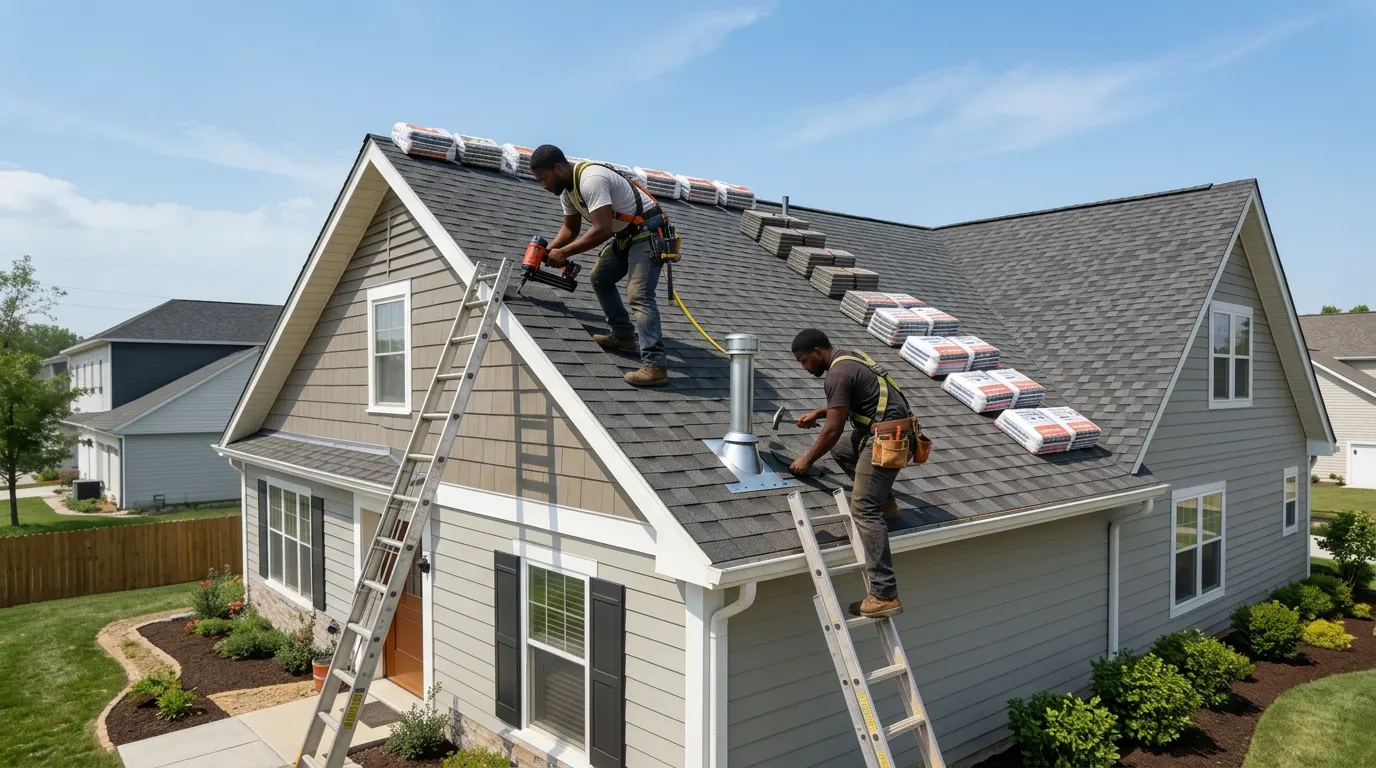
Roof leaks, failed flashing, clogged gutters and plumbing drips cause damage that compounds. EPA advises fixing water problems as soon as possible and drying wet materials within 24 to 48 hours. If you see ceiling stains, begin with roof leak repair.
Check the equipment that can quit on you
ENERGY STAR suggests having heating and cooling equipment more than 10 years old evaluated, and sealing duct problems before assuming the unit is at fault. Planning a replacement through our HVAC services is easier than dealing with one in a July failure.
Deal with safety and access
Loose railings, soft deck boards and uneven steps come next. A deck repair visit is a small job compared with what a fall could cost.
Then the rooms you live in
Once the house is dry and running, money for a kitchen, a bathroom or new floors goes further, because you won’t be tearing it out to fix something behind it.
Last, what shows from the street
Paint and exterior refreshes matter, and they’re also the easiest to phase. Do them after any roofing work, which can scuff what’s beneath it.
That order is a default rather than a rule. An owner preparing to sell, or one with a failing shower directly over a finished room, would reasonably shuffle it.
What a home service handyman can and can’t carry
People look for a home service handyman because they want one call to take care of many small things. In a town full of 20- and 30-year-old houses, that’s a sensible instinct. Worn door hardware, popped nails in drywall, a cracked tile, a dripping fixture and sagging trim are all fair game for handyman work, and bundling them saves you separate appointments.
But some items look small and aren’t. A stain on a ceiling may be the visible end of a long roof problem. A soft spot in a bathroom floor can mean rotted subfloor. A door that suddenly sticks might be seasonal, or might point to something moving. Anyone looking honestly at those should tell you when the job has outgrown a repair visit.
Because Twelve25 also handles full remodels, roofing, plumbing and HVAC, the conversation can go either way. If you only need the list worked through, that’s fine. If you’d like to know what the list adds up to, ask for that as well.
Things owners in this age group commonly ask about
- Builder-grade kitchens and baths that have reached the end of their looks, if not their function
- Carpet or early laminate ready to give way to LVP or ceramic tile
- Original windows and doors that have started to leak air
- Attic insulation and duct connections nobody has looked at since the house was built
- Interior paint that was never redone after move-in
Finding out what has already been replaced
With houses this age, many have changed hands at least once, and the current owner may not know what’s original. A little detective work can save you from replacing something that’s only a few years old, or from trusting something that’s near the end.
- Dig out the inspection report from when you bought the house. It often records approximate ages for the roof, water heater and HVAC.
- Read the data plates on the outdoor condenser, furnace or air handler, and water heater. A photo of each gives a contractor a place to start.
- Go up into the attic with a flashlight on a dry day. Dark stains on decking, compressed insulation and disconnected duct joints all tell you something the rooms below won’t.
- Compare your roof with others on your street. Houses of a similar age with new shingles may mean a storm claim or a replacement cycle you missed, though it’s not proof either way.
- Look through any receipts the previous owner left, and ask the Codes Department what permit records it can share for your address.
- Look under sinks and around the water heater for old stains or corrosion, which can reveal a past leak that was never mentioned.
Write what you find on a single page, with a rough year next to each item. That sheet turns a vague worry into a plan you can put in order, and it makes any estimate conversation much shorter. A 1995 house with a 2015 roof and original HVAC has very different priorities from a 2005 house that has had nothing done.
The city’s permit system is online
La Vergne’s Codes Department issues permits, conducts inspections and enforces the city’s adopted codes, currently 2024 editions of the International Residential, Building, Plumbing, Mechanical and Fuel Gas codes, with local amendments. Its page says building permit applications and inspections must go through the Community Development portal, and a tool called the Decision Engine can help you figure out where to start.
A few details differ from what you might assume:
- Electrical permits and inspections come from the Tennessee State Fire Marshal’s office rather than the city.
- Everyone pulling a permit must show workers’ compensation coverage or an affidavit of exemption.
- Applications must include all required documents when submitted, so an incomplete package won’t count.
- The permits page lists separate permit paths for decks, sheds and fences, and notes a fence or barricade requirement where there’s a swimming pool.
Ask the Codes Department about your specific project before you start. A like-for-like repair and a new deck aren’t treated the same, and we won’t try to answer code questions on the city’s behalf.
Lake, creeks and hard rain
La Vergne borders Percy Priest Lake to the northeast, but a lake view isn’t the only reason to think about water. When storms hit the region on September 13, 2020, NewsChannel 5 reported that officials here closed multiple roads because of high water. FEMA’s flood map tools can show you whether a given parcel is mapped as high risk, though FEMA is clear that no area is entirely without risk.
For a house, that translates to some routine checks. Walk the perimeter during a steady rain if you can. Notice where water stands, and whether downspouts drop it next to the foundation. Gutter cleaning and regrading small low spots are humble jobs, yet they head off expensive ones. After 20 or 30 years, soil settles around a foundation, and a slope that once carried water away may now hold it there.
The city also has a Stormwater Department listed in its directory. If an addition, a shed or new paving will alter how water leaves your lot, call them before finalizing plans. Drainage disputes between neighbors are far easier to prevent than to settle.
Older homes, and one test worth running
About a fifth of the city’s houses were built before 1990. Some of those may predate 1978, which matters because EPA’s lead-safe rule applies to paid renovation work that disturbs painted surfaces in those homes. If yours is in that group, tell any contractor the year built before anyone starts sanding or cutting.
Radon applies to every age of house. Rutherford County is in the highest category on EPA’s radon zone map, and the agency recommends that all homes be tested whatever the zone. It’s an inexpensive step, and worth doing before closing up any ground-level room.
We serve La Vergne with free estimates and a written scope with clear pricing, so you can compare phases side by side. For a look at how nearby housing differs, see Smyrna, four miles south, or Nolensville, where most homes are far newer. When you’re ready, send us your list.
Sources for Local Facts
- City of La Vergne: Codes Department
- City of La Vergne: Permits, General Rules and Ordinances
- City of La Vergne: Stormwater Department directory
- Wikipedia: La Vergne, Tennessee
- NewsChannel 5: Flooding closes many roads in Nolensville, La Vergne
- EPA: A Brief Guide to Mold, Moisture and Your Home
- EPA: Renovation, Repair and Painting Program
- EPA: Map of Radon Zones, Tennessee
- FEMA: Flood Maps
- ENERGY STAR: Heat and Cool Efficiently
Let’s Build Something Great Together.
Ready to start your next construction or remodeling project? Tell us about your space and request a free estimate.