
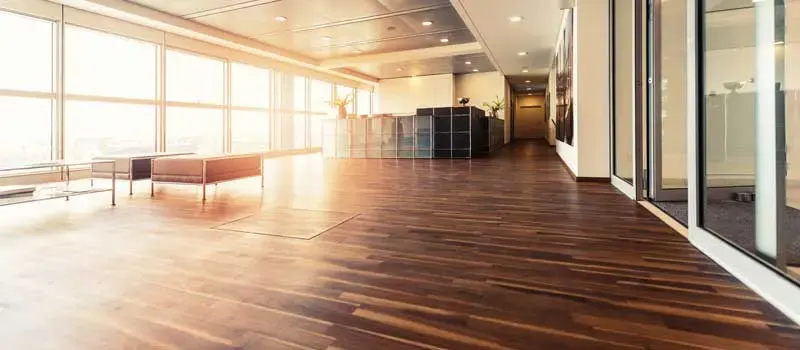
Quality Floors. Built to Last.
Luxury Vinyl Plank (LVP) and Ceramic Tile Installation in Atlanta, GA and Nashville, TN
Planks that peak at the seams, tile that cracks, edges that catch your toes, grout crumbling in the shower. Most of it traces back to what happened before the finish material went down.
Trouble With Vinyl Plank
This page is only about two materials. If you are still comparing floor types or dealing with squeaks and soft spots, our general flooring guide is the place to begin. If you already have LVP or tile, or you have settled on one, the problems below are the ones worth understanding. Good LVP and ceramic tile installation depends less on the product in the box than on layout, preparation and how water is handled.
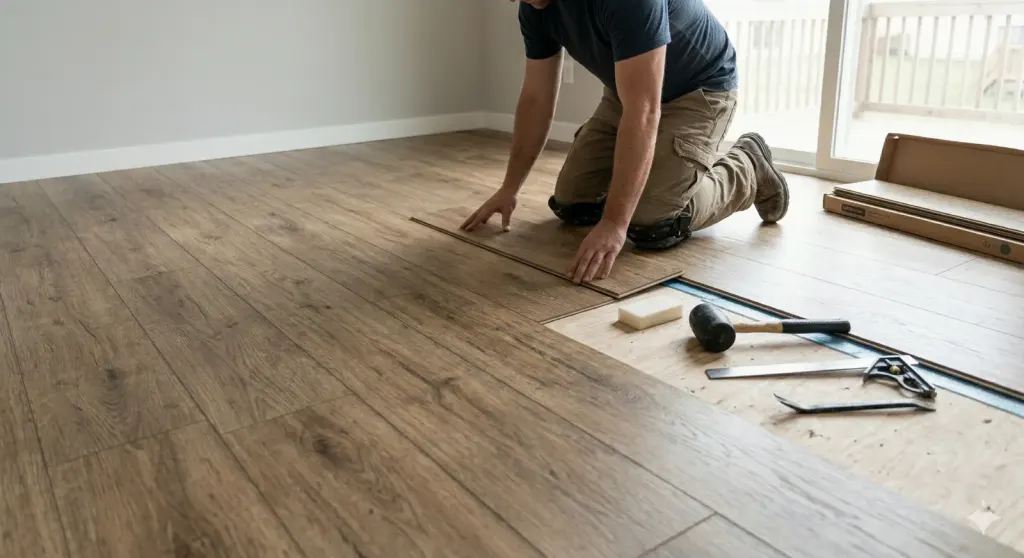
Planks rising into a ridge at the seams
Installers call this peaking. Vinyl plank is often laid as a floating floor, meaning it is locked together and rests on the subfloor without being fastened, so it needs room to move. When something pins it, such as kitchen cabinets set on top, a heavy island, tight baseboards or door casings cut too close, it has nowhere to go when it expands, so it rises where the joints are weakest. Strong afternoon sun through a glass door can drive the same movement.
Check whether the ridge runs along a line or sits near one pinch point. A ridge that appears in hot weather and relaxes in cool weather is an early warning. Treat it as a matter of weeks or months and not an urgent problem, unless the raised edge is catching feet. Left alone, the locking edges can break, and that turns a simple correction into plank replacement.
The usual fix is removing trim, cutting back whatever is pinning the floor to restore the expansion gap, and reseating the planks. If the joints are chewed up, those planks get replaced. When the whole floor was laid under cabinets, a section may need to be re-laid.
Seams separating, or a plank that clicks and flexes
A click underfoot usually means a low spot under the plank. The floor flexes across the dip with every step until the locks tire and the seam opens. Thin LVP also tends to show every bump beneath it, a problem called telegraphing, where old grout lines or a rough patch appear through the surface.
Separated seams are rarely urgent, but do not mop a floor with open joints. Repairs depend on how far the problem has spread. Lifting from the nearest wall, filling the low spot and re-clicking works for a limited area. A floor that flexes throughout was probably laid on poor preparation, and pulling it up to flatten the base is the honest answer, since spot fixes keep reappearing.
Planks swollen or stained after a leak
Water-resistant describes the plank, not what lies underneath it. Water can travel through joints and sit on the subfloor, where it stays hidden. If a plank is soft, discolored or smells musty, take it up and see. Shut off the source first. Then let the base dry before new material goes in. Spreading growth underneath means you stop there and call a mold professional.
Trouble With Ceramic Tile
A crack running through several tiles in a line
One cracked tile is often just a dropped pan. A crack that crosses several tiles in a straight line is different, because it usually follows something below: a joint in the slab, a crack in the concrete, or a wood subfloor that flexes too much for a rigid surface. Tile set straight onto a moving base will crack sooner or later.
To judge how serious it is, look at whether the line is growing and whether the tile edges have shifted out of plane. Cosmetic cracks can wait. Sharp edges in a bare-foot room cannot. A big new crack that also shows up in nearby walls, or a floor that has started to sink, is a reason to stop and call a professional about the structure before thinking about tile again.
A single tile can be cut out and replaced if you have a match. Spare tile from the original job is worth keeping for exactly this reason. Where the crack comes from the base, new tile alone will crack in the same place. The repair needs an isolation layer or stiffer support, which usually means taking up a whole section.
Hollow-sounding tiles, or ones that rock
Tap across the floor with a wooden handle. A clear tone means good bond and a dull, hollow knock means the tile has let go of the thin-set beneath. Poor coverage during setting, a dusty surface, or movement are the common causes. A few hollow tiles in a quiet spot can be watched. Loose tiles around a toilet or in a wet area should be dealt with soon, since broken grout lets water in. When hollow spots spread across a room, the bond has failed as a system and full replacement usually costs less than endless patching.
Edges that stick up and catch your toes
That height difference between neighboring tiles is called lippage. Some of it is built into the product, as larger tiles often have a slight bow. Most of the rest comes from a subfloor that was not flat, or from a layout that staggered long tiles in a way that exaggerated the bow. Low light along a hallway makes it obvious.
This one is mostly cosmetic, unless an edge is high enough to trip someone or chip. It cannot be sanded away on ceramic, so a true fix means removing the affected tile and resetting it on a flattened base. Before tile goes down, ask for a dry layout and a check of the flatness requirement listed by the tile maker. That is far cheaper than correcting it afterward.
Grout that crumbles, stains or falls out
Grout problems come from a weak mix, too much water when it was sponged, heavy cleaners that eat at it, or movement at spots where a soft joint belonged. Where floor meets wall, or tile meets a tub, a flexible sealant should sit rather than hard grout. Cracks at those corners are a sign of that mistake.
Can wait
Dull or stained grout on a dry floor. Deep cleaning and sealing, or a color treatment, may be all it needs.
Plan it soon
Missing grout on a kitchen or entry floor, where grit and mop water get under tile edges.
Do not wait
Open joints in a shower or on a bathroom floor, especially with loose tile or staining on the ceiling below.
Regrouting works when the tile is firmly attached. If tiles move when pressed, new grout will crack again within a short time, so the tile has to come up.
Wet areas that were not built for water
Grout and tile are not waterproof on their own. In a shower, the protection lives behind the tile, in a membrane or waterproof backer system, plus proper slope to the drain. If you see darkened grout that never dries, soft wall areas, or a smell you cannot trace, the failure may be behind the surface. Rules for wet-area construction vary, so ask your local permit office if you have questions. A failed shower is usually a rebuild, and that belongs with a bathroom remodel.
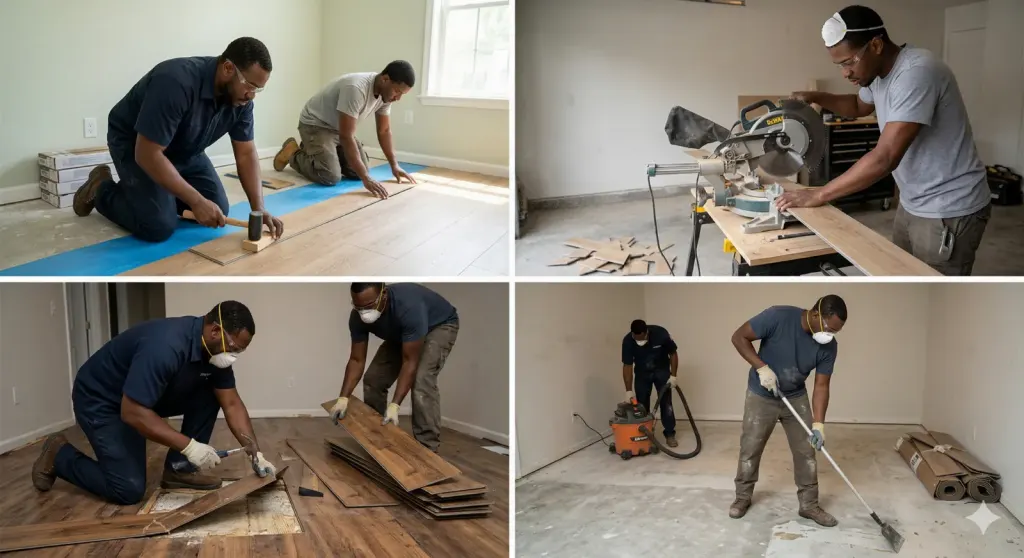
Why Preparation Decides the Outcome
Most of the failures above begin before the first plank or tile. Our removal work covers tile, hardwood, carpet and vinyl, along with disposal of materials and surface preparation. From there, subfloors are inspected and repaired, leveled and smoothed, and a moisture barrier goes in when needed.
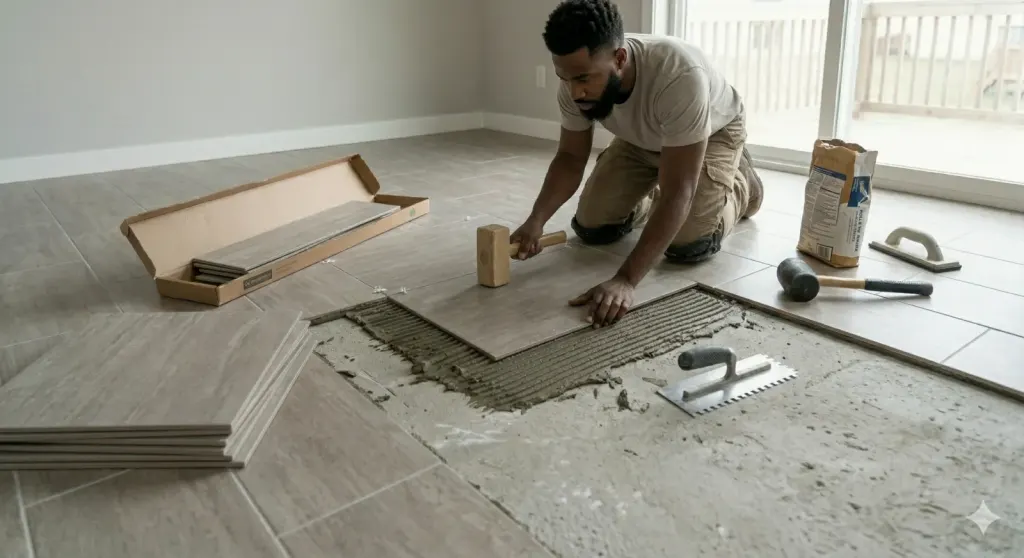
One caution for older homes. Old vinyl flooring and the adhesive under it can contain asbestos. Have it tested before anyone cuts, scrapes or sands it.
Choosing between the two
LVP is low maintenance, long-lasting and budget-friendly compared to hardwood, with wood-look finishes and water-resistant, scratch-resistant options. It is forgiving and comfortable underfoot. Ceramic is well suited to bathrooms, kitchens, entryways and commercial spaces, and it is harder wearing where water is a daily fact, though it demands a stiffer, flatter base and more hands-on time.
How a project runs
Consultation and estimate
A clear project scope and pricing, with a free estimate to start.
Preparation and removal
Old flooring comes out and subfloors are prepared properly.
Installation
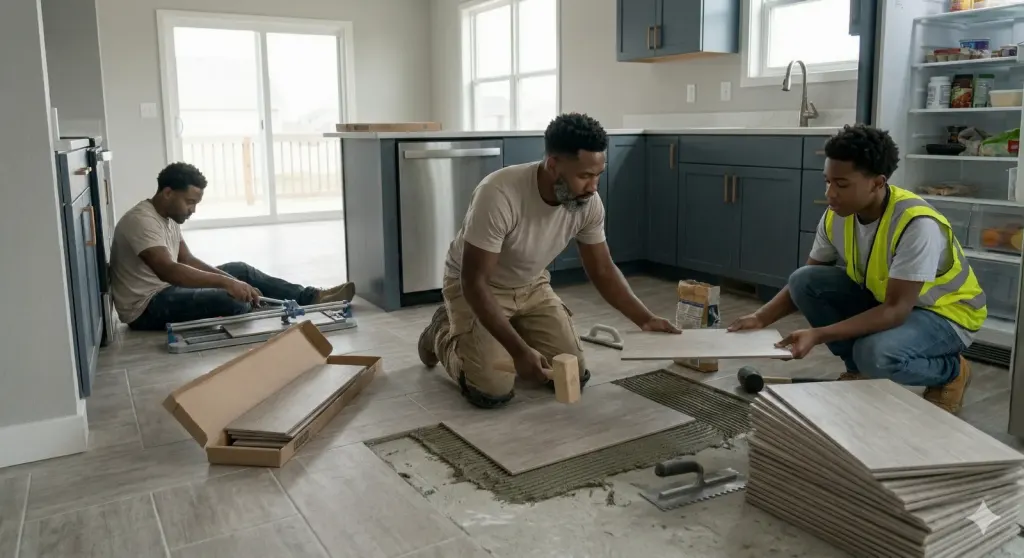
LVP with precise layout and clean transitions, or ceramic tile with custom layout, precision cutting, grouting and sealing.
Final walkthrough
We confirm everything meets your expectations.
Time and cost hinge on a handful of things: what is being removed, how far out of flat the base is, slab or crawlspace moisture, tile size and pattern, the number of cuts and transitions, and whether fixtures or cabinets have to come out. We serve residential and commercial properties in the Atlanta and Nashville areas, and we are licensed and insured.
What to Ask an Installer
- Where will the expansion gaps go on LVP, and will the floor run under cabinets or stop at them?
- How will you check the flatness of the base, and what will you do about low spots?
- On tile, what is going under it: backer, an uncoupling or isolation layer, or thin-set straight on the slab?
- How do you plan a layout so cut pieces at the walls are not tiny slivers?
- Where will flexible sealant replace grout?
- Which grout type will you use, and does it need sealing?
- Can I keep extra tile or planks from the same lot for later repairs?
Answers should come quickly and be specific. Vague ones about any of the above are the signal to keep looking. When you are ready to compare, you can ask us for a free estimate for your LVP or tile project.
LVP and Tile Questions
Is LVP truly waterproof?
Many planks tolerate water well, but the seams and perimeter are still openings and the subfloor below can still get wet. Clean up spills, fix leaks fast, and read what the product maker says about wet rooms.
Can LVP go over my existing tile?
It can if the tile is solidly stuck down and the grout lines are filled and flattened so they do not show through. Check door clearances, and check the product instructions, because some makers limit it. Loose tile should come out first.
Why did my new tile crack within a year?
A floor that flexes, a slab crack that was tiled over, or no isolation layer are the usual suspects. A dropped object tends to leave a single, starburst-shaped break, while movement leaves a line through several tiles.
Can I replace just the grout?
Yes, if the tiles are solid. Press on them and listen for hollow spots first. New grout will not hold loose tile in place, and in a shower it will not fix failed waterproofing behind the wall.
Should vinyl plank go under my kitchen cabinets?
Many floating products should not be pinned by cabinets or heavy islands, and that is a common cause of peaking. Follow the manufacturer’s instructions, and plan the flooring as part of the larger kitchen work so it goes in at the right moment.
Which is easier to live with, LVP or tile?
LVP is warmer, quieter and more forgiving of a dropped plate. Tile lasts through more scrubbing and standing water. Think about who walks on it, what spills, and whether a repair later would be simple.
Serving the Nashville and Atlanta Areas
We provide LVP and tile flooring within 40 miles of Nashville, TN and within 40 miles of Atlanta, GA. See the areas we serve, or call (615) 478-5705 in Nashville or (770) 669-1314 in Atlanta.

Let’s Build Something Great Together.
Ready to start your next construction or remodeling project? Tell us about your space and request a free estimate.