
Older houses, a big river
Bathroom Remodeling Columbia TN: Working With Older Homes Near the Duck River
Columbia's homes run far older than those in Spring Hill or Thompson's Station, and the city adds historic districts and a river with a long flood record. Each of those changes how a bathroom project should begin.
Columbia at a Glance
- Location
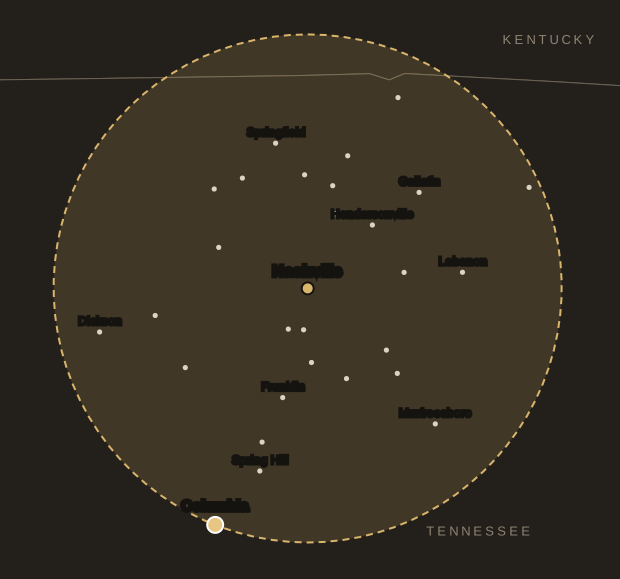
- 40.0 miles south of central Nashville (straight line)
- County
- Maury County
- Population (2023 estimate)
- 47,445
- Housing units
- 19,160
- Median year homes were built
- 1979
- Owner-occupied homes
- 64%
- Detached single-family homes
- 69%
- Built before 1970
- 35%
- Built 2010 or later
- 18%
Sources: US Census Bureau 2023 Gazetteer, Vintage 2023 population estimates, and American Community Survey 2023 5-year estimates for the place. County is taken at the place’s center point; some communities extend into other counties.
What you might find behind a Columbia bathroom wall
Columbia’s median home dates to 1979, compared with 2008 in Spring Hill just to the north. Census shares show why: 12% of homes predate 1950, 23% are from 1950 to 1969, another 23% are from 1970 to 1989, 24% are from 1990 to 2009 and 18% are newer. So more than a third of the city’s 19,000 or so units are at least 55 years old, and nearly six in ten were built before 1990.
That age matters more in a bathroom than in almost any other room. A bath is small, but it holds water supply, drains, venting, wiring and moisture in tight quarters, and it’s the room most likely to have seen a slow leak nobody noticed. For bathroom remodeling Columbia TN homeowners should treat the first days of demolition as a discovery period and leave room in the plan for what turns up.
By era, here’s what deserves a question
Before 1950
Original or much-altered plumbing and wiring are both possible, along with framing and floors that have sagged over time. A previous owner may have added this bathroom in a closet or porch, so the layout may not follow any logic you’d expect.
1950 to 1969
Tile-on-mortar walls and floors are common in homes of this age and can be sound but heavy to remove. Ask what supply and drain lines are made of, and whether a full plumbing update should happen while walls are open.
1970 to 1989
Fiberglass surrounds and early vanity layouts are often dated rather than broken. Paint from before 1978 is a separate concern, discussed below. Fans from this period, if there’s a fan at all, are often weak.
1990 and newer
Usually a cosmetic or layout project: larger shower, better storage, new tile or LVP. Waterproofing behind the original tub surround is still worth checking.
These are likelihoods rather than diagnoses. Nobody can tell you what’s in your walls by the year on a deed, which is why we’d rather look before writing anything down.
Lead paint comes first in a pre-1978 bath
EPA’s Renovation, Repair and Painting rule applies to paid work that disturbs painted surfaces in homes built before 1978. In a bathroom remodel, that’s nearly everything: cutting drywall, pulling trim, removing a window casing, sanding a door. EPA’s guidance is that homeowners should hire a contractor who follows the rule, and it notes that children can live safely in older homes when paint and surfaces are kept in good condition. Peeling paint and the dust it creates are the main hazards.
If you do any of the demolition yourself to save money, read EPA’s do-it-yourself lead-safe advice first. If you rent out the home, the owner exemption doesn’t apply to you. Mention the year built at the very start, so testing and containment are planned instead of being an awkward surprise halfway through.
A bath built to dry out
Mold complaints in older homes usually trace back to water that wasn’t dealt with or air that never left. EPA’s moisture guide says to fix plumbing leaks as soon as possible, dry wet materials within 24 to 48 hours, and run a fan or open a window while showering. It adds that if you only clean the mold without fixing the water problem, it will likely come back.
In practical terms, a well-planned older-home bath usually includes these decisions:
- A vent fan that actually exhausts outside, not into the attic or a wall cavity
- Subfloor inspection once the old flooring is up, especially around the toilet and tub
- Proper waterproofing behind tile in wet zones instead of relying on the tile itself
- Pipe repairs handled now, while everything is exposed, rather than through a new tile wall later
- Moisture-appropriate drywall and fresh paint suited to a humid room
Check the outside as well. If a bathroom’s exterior wall stays damp, the cause could be a clogged gutter or soil sloping toward the house, and neither one is solved from indoors. Gutter cleaning and a look at the siding may belong on the same list.
The Duck River sets the terms for some lots
Columbia grew up along the Duck River, described as the longest river located entirely within Tennessee. The National Weather Service gauge record at Columbia sets minor flood stage at 32 feet, moderate at 37.5 and major at 41.
The flood of record reached 51.75 feet on February 14, 1948. Other high marks include 49.31 feet in 1973, 48.31 in 1975 and 46.80 in 1991. In May 2010 the river reached 44.91 feet, only its seventh highest level. According to the gauge’s impact notes, significant flooding reaches Riverside Drive and structures in Columbia at 38 to 40 feet. In one flood with a 42-foot crest, NewsChannel 5 reported that fire and police crews went door to door urging Riverside residents to leave.
If your home is near the river or its tributaries, look up the parcel on FEMA’s flood map resources before designing anything on a lower floor. A first-floor bath in a house that has taken water is a different project. Materials that can tolerate wetting, and where the electrical and mechanical items sit, both deserve thought. Ask the city what applies, since substantial work in a mapped area can bring added rules.
Historic districts: inside versus outside work
The city’s Historic Zoning Commission is its official preservation review body. Its Certificate of Appropriateness application states that building or demolition permits can’t be issued without an approved certificate for structures within a historic district, and that a pre-application meeting is required before submittal. The commission follows the Secretary of the Interior’s Standards for Rehabilitation and the city’s own design guidelines.
The application’s checklist is organized around new construction, new additions, exterior alterations, and demolition or relocation. So an interior bath update and a new bathroom bump-out on the rear of the same house may be treated very differently. A replaced window or a new exterior vent cap could also raise a question. Don’t guess; ask Development Services whether your address is in a district and whether your scope counts.
Age isn’t confined to those districts, either. Columbia was laid out in 1808, and the same entry says Maury County has more antebellum houses than any other county in Tennessee. It also reports growth from 21,471 residents in 1970 to 41,690 in 2020. So older houses sit alongside a good deal of newer construction. If you’re remodeling something truly old, it’s worth deciding early which original features to keep, such as a window, a door or a piece of trim, before demolition makes the choice for you.
Living through the work, and choosing what to change
A remodel in an older house raises a practical problem that newer homes often avoid: some houses have only one bathroom. If that’s yours, plan around it from the first conversation. Ask how long the toilet and shower will be out of service, whether a temporary fixture or a phased sequence is possible, and where your household will go on the days nothing works. It’s better to make those arrangements in advance than to discover the gap with the floor already up.
Layout choices also deserve a slow look. An older bath is often narrow, so small moves can make a big difference, while big ones may mean moving a drain stack.
- Swapping a tub for a walk-in shower is a common request, particularly for owners planning to stay long-term. If it’s the home’s only tub, consider how that affects daily use and a future buyer.
- Grab-bar blocking costs little to add while the wall is open, even if you don’t want bars yet.
- Moving a toilet usually means opening the floor. On a crawl-space house that’s often manageable, while on a slab it’s a larger job.
- Adding a second bath in an unused closet or under a stair can be more valuable than expanding the first, if venting and drains can reach it. In a one-bath house, that’s worth asking about before you settle on a plan.
A crawl space under the floor is also a chance to look at insulation, supply lines and any dampness while you have the access.
Steps for a Columbia bathroom project
Confirm who has jurisdiction
A permit guide says City of Columbia Development Services handles permits and inspections inside the city limits, and that Maury County’s office doesn’t cover the city. Outside the limits, ask the county.
Ask about trade permits
The city’s business page lists online trade permits for mechanical, plumbing and gas piping work, among others. Moving a drain or a vent may need one even when the rest of the job doesn’t.
Gather the basics
Year built, any past water damage, whether the house is in a historic district or mapped flood zone, and your must-haves. Photos help.
Get a written scope
We serve Columbia, and our bathroom remodeling services start with a free estimate. Before work begins, you’ll have a detailed scope and clear pricing, with allowance for what older walls can hide.
Think beyond the one room
If the kitchen shares a wet wall or the whole house needs attention, a broader remodel plan may save tearing into the same pipes twice. And Maury County sits in Zone 1 on EPA’s radon map, so a simple test is sensible for any home, new or old.
Columbia lies about 40 miles south of Nashville, at the southern edge of the area we serve. Owners comparing nearby housing can see our notes on Spring Hill, where almost everything is newer, or send us your project details directly.
Sources for Local Facts
- NOAA National Water Prediction Service: Duck River at Columbia gauge data
- National Weather Service Nashville: May 2010 flood
- NewsChannel 5: Duck River crest and Riverside evacuations
- City of Columbia: Historic Zoning Commission Certificate of Appropriateness application
- City of Columbia: Opening a Business
- Jaspector: Columbia building permit guide (third-party)
- Wikipedia: Columbia, Tennessee
- EPA: Renovation, Repair and Painting Program
- EPA: A Brief Guide to Mold, Moisture and Your Home
- EPA: Map of Radon Zones, Tennessee
- FEMA: Flood Maps
Let’s Build Something Great Together.
Ready to start your next construction or remodeling project? Tell us about your space and request a free estimate.