
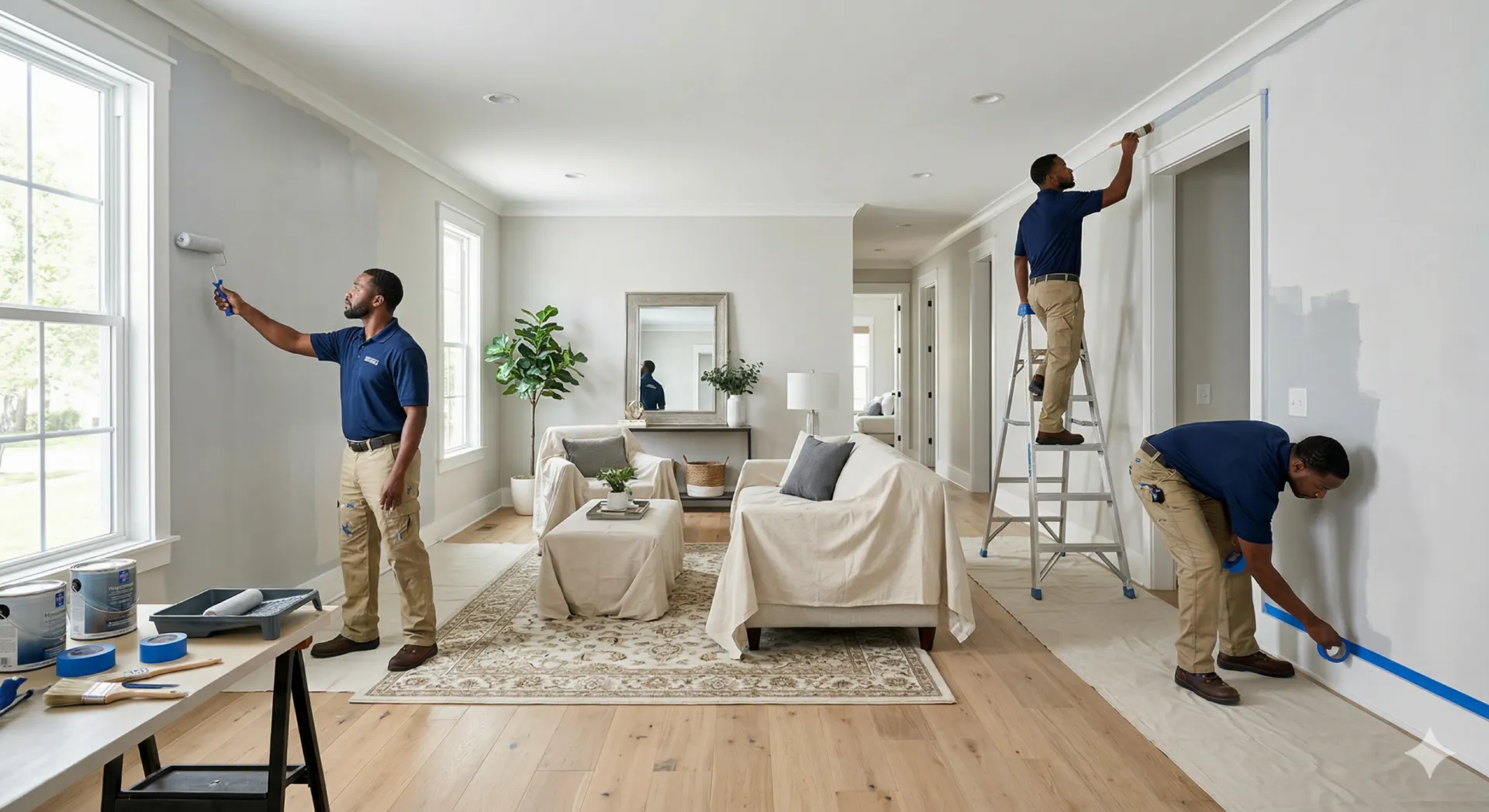
Repainting 1990s and 2000s walls
Interior Painting in Kennesaw, GA
Most Kennesaw houses are old enough to have been repainted at least once by now, and young enough that the real work is in the prep. A few honest notes on getting a repaint right.
Kennesaw at a Glance
- Location
- 23.3 miles northwest of central Atlanta (straight line)
- County
- Cobb County
- Population (2023 estimate)
- 34,683
- Housing units
- 14,134
- Median year homes were built
- 1997
- Owner-occupied homes
- 69%
- Detached single-family homes
- 60%
- Built before 1970
- 7%
- Built 2010 or later
- 12%
Sources: US Census Bureau 2023 Gazetteer, Vintage 2023 population estimates, and American Community Survey 2023 5-year estimates for the place. County is taken at the place’s center point; some communities extend into other counties.

What a house from this era usually needs
Census data shows 61% of Kennesaw’s housing units were built between 1990 and 2009, with a median year of 1997. Another 12% are newer, and only 7% predate 1970. That is a remarkably concentrated stock. Owners occupy 69% of units, and 60% are detached houses, so the rest are townhomes, apartments and other attached homes.
What does that mean on a wall? Age alone cannot tell us what is under your paint. Even so, a house that is 25 to 35 years old has generally had enough seasons for wood framing to settle, for corner bead and fasteners to start showing, and for previous quick touch-ups to become visible in raking light. It also may have had one or two rounds of paint that went on fast, sometimes over a surface that was never cleaned. The result is a repaint that depends more on preparation than on a color choice.
This page is about those preparation decisions, along with the smaller share of older homes and rentals where the rules and priorities differ.
Before the first brush: a room-by-room walk
Bring a bright flashlight and hold it close to the wall at a shallow angle. Light skimming across a surface exposes things that overhead fixtures hide. Note what you see on your phone, and put a strip of painter’s tape beside each item.
Stairwells and tall walls
These spaces tend to show the most movement and the worst touch-up marks. Check the upper corners, and think about access, because ladders and planks will change the setup on a two-story foyer.
Bathrooms
Peeling near the ceiling and spotting around the fan point to moisture. EPA guidance recommends fixing the moisture source first, since cleaning alone rarely holds. Check whether the fan actually vents outside.
Kitchens
Grease film will defeat good paint. Walls and cabinets near the range need real degreasing, then a suitable primer where staining persists. A semi-gloss or scrubbable finish tends to suit this room.
Ceilings
Look for brown rings and new cracks. A stain below a bath or attic may be old or may be active, so find out which before covering it. If it is a roof issue, have a leak traced and repaired first.
Trim and doors
Sticky doors, old brush marks and caulk that has separated all show up here. Decide whether trim stays the same color. A change from old cream to crisp white is a larger job than it sounds.
Garages and bonus rooms
These often have unfinished tape lines, patches or an earlier builder finish. A bonus room over a garage may also run hot and cold, which is worth noting if you see cracks returning.
Drywall repair comes first
Paint highlights a damaged surface. Fix the board, and the whole job looks better. In houses built in the 1990s and 2000s, a few recurring items are worth addressing before any new color goes up:
- Nail or screw pops, which show as small round bumps along framing lines
- Hairline cracks at door and window corners, which can return if the cause is movement
- Loose or dented corner bead on stairwells and hallways
- Old anchor holes from shelves and TV mounts, often filled quickly by a prior owner
- Flashing, where patches look dull or shiny under a fresh coat because they were not primed
- Water-stained areas that need a stain-blocking primer once the leak has been dealt with
A larger crack that keeps coming back, or a door frame that is racking out of square, deserves a closer look before it gets filled again. Our drywall repair service and painting service work together for jobs like these. If a soft or stained area turns out to be wet behind the surface, the scope changes, and it is better to find that out now.
Choosing sheens and products without overthinking it
Flat or matte
Hides surface flaws well, which suits ceilings and many older drywall walls. Modern washable matte lines handle light cleaning better than the old flat paints did.
Eggshell or satin
A common choice for bedrooms, halls and family rooms. A slight sheen wipes clean, though it shows patching more than flat does, so prep matters.
Semi-gloss
Often used on trim, doors, kitchens and baths. It cleans easily and also highlights every imperfection, which is why careful sanding pays off here.
Primer
Needed on bare patches, stains, heavy color changes and glossy older coats. A coat of primer in the right spots can save an extra finish coat later.
Air quality deserves a thought too, especially with kids, pets or anyone who has breathing concerns at home. The EPA notes that paints and paint strippers release organic compounds, and it advises extra ventilation while they are in use. Open windows when the weather allows, follow the label, and do not keep half-used cans indoors out of habit. Low-odor products are widely sold now, and it is reasonable to ask for them.
Picking color in actual light
Try large samples on more than one wall, then look at them in the morning and after dark. Rooms facing north read cooler. Your flooring affects colors more than most people expect, so if you plan new flooring, choose it first, or at least bring a sample.
What a painting proposal should list
A quote that says only “paint three rooms” leaves too much open. Ask each painter to put these items in writing, so you are comparing the same job:
- Which surfaces are included, specifically walls, ceilings, trim, doors, closets and window sills
- What patching, sanding, caulking and priming will be done, and where
- The product line, sheen and number of coats for each surface
- Who moves furniture, takes down wall hangings and removes switch plates
- How floors, stairs and any finished cabinets will be protected
- What happens with leftover paint, and whether color names and formulas will be left with you
Clearing shelves and taking pictures down before the start date makes things go more smoothly. Rooms with heavy furniture may need a plan for where it goes, particularly upstairs. It also helps to decide early whether closets are in or out, because they add more time than their size suggests.
Older homes, rentals and the historic district
Although most Kennesaw housing is recent, 7% of units predate 1970, and a house built before 1978 needs a different approach. The EPA’s renovation, repair and painting rule covers paid work that disturbs paint in those homes. It applies to rental owners as well, so landlords should plan for it. If you are not sure of a home’s age, check the county property record before anyone starts sanding.
With 31% of units not owner-occupied, turnover painting is also common here. Kennesaw State University is nearby, and although we cannot tell you how many rentals serve students, a landlord between leases has different goals from an owner planning to stay for years. Durable, easily touched-up finishes and a standard color palette usually make more sense. Keeping the color names and sheen on file saves money the next time around.
Inside is one thing, the outside is another
The city’s Planning and Zoning page describes a Historic Preservation Commission, 2006 design standards and a Certificate of Appropriateness application. It also explains how to look up your parcel: click on it in the city’s online map and read the field marked Within Historic District. Those standards were not summarized on that page, so ask Planning and Zoning at 770-590-8268 whether a given project is affected. Plain interior repainting is unlikely to be the focus of a design review, yet an exterior door or a porch might be. Do not assume either way.
Permits
Kennesaw Building Services does not say on its page which work needs a permit, and it invites questions at (770) 429-4554 or permits@kennesaw-ga.gov. Repainting alone is not the kind of work that usually triggers one, but moving a wall or replacing a section of drywall as part of a bigger remodel may be different. Applications go through the city’s online portal. Homeowners who pull their own permits need a Homeowners Affidavit.
Questions Kennesaw homeowners may ask
Who should handle interior painting Kennesaw GA townhome owners are planning?
Check with your association first, though most interiors are yours to decide. Choose someone who will describe prep in writing, room by room, and protect shared walls and floors during work.
Our last painter left visible patches. Can they be fixed without redoing the whole room?
Sometimes. Patches often show because they were not primed or the sheen differs. In many cases, you end up repainting that wall corner to corner, since a partial touch-up on older paint rarely blends.
Is it better to paint before or after new floors go in?
Most of the time, paint first and do the final touch-ups after the floors and base are in. Protect any new floor well if the order has to be reversed.
Our house has a vaulted family room. Does that need special handling?
Often it does. Height affects staging, ladder work and how visible roller marks will be in sidelight. Mention it when you ask for a free estimate, ideally with a picture.
Can we bundle painting with other small repairs?
Yes. Our handyman work can take care of door hardware, loose trim and similar items while a painter has the room cleared.
Houses in Acworth have almost the same age profile, while Marietta has a much larger share from the 1970s and 1980s, where old coatings can be a bigger part of the job.
Sources for Local Facts
Let’s Build Something Great Together.
Ready to start your next construction or remodeling project? Tell us about your space and request a free estimate.