
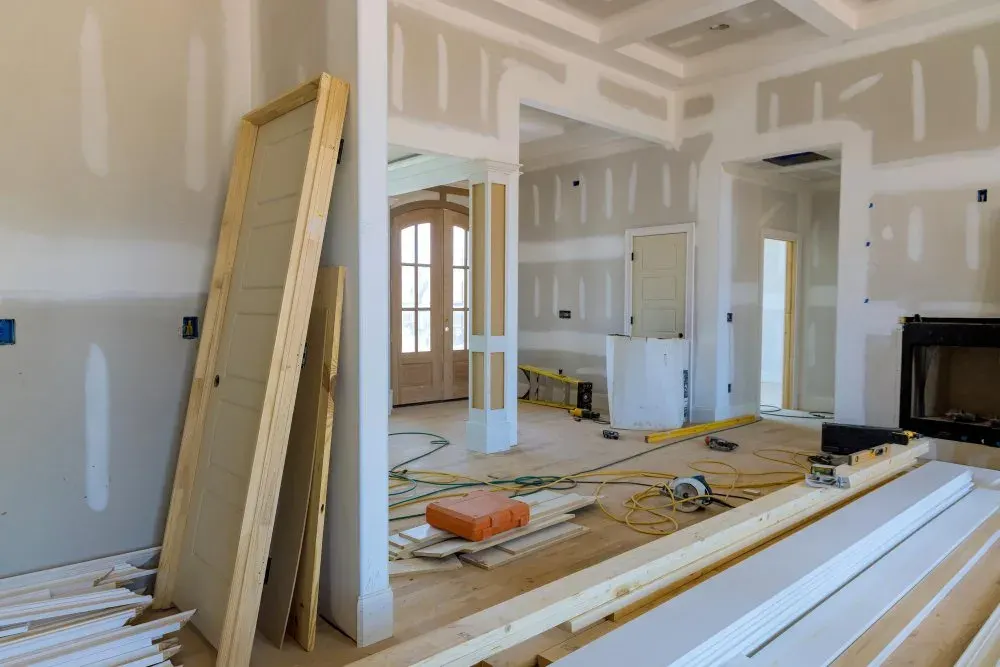
Walls, ceilings and shared partitions
Drywall Repair for Woodstock, GA Homes
Nearly nine in ten Woodstock homes went up after 1990, so wall trouble here tends to come from settling framing, hidden leaks and shared townhome walls rather than from old age. Here is how to read the damage and decide what kind of repair it needs.
Woodstock at a Glance
- Location
- 25.5 miles north of central Atlanta (straight line)
- County
- Cherokee County
- Population (2023 estimate)
- 38,473
- Housing units
- 14,979
- Median year homes were built
- 2005
- Owner-occupied homes
- 66%
- Detached single-family homes
- 59%
- Built before 1970
- 0%
- Built 2010 or later
- 30%
Sources: US Census Bureau 2023 Gazetteer, Vintage 2023 population estimates, and American Community Survey 2023 5-year estimates for the place. County is taken at the place’s center point; some communities extend into other counties.

A young housing stock with its own wall problems
Woodstock has deep roots for a suburb. The city’s history page dates the railroad depot to 1879 and the city charter to 1897, and it counts just 276 residents in the 1900 census. Interstate 575 did not arrive until 1982. What followed reshaped the housing stock completely: Census figures show 58% of homes built between 1990 and 2009 and another 30% built in 2010 or later. Homes from before 1970 round down to almost nothing in the data, even though the town itself is much older than its houses suggest.
That timeline matters when you look at a crack in the wall. Plaster failure, a common worry in far older towns, is not the usual story here. The usual story is gypsum board that has been up for 15 to 35 years, hung over lumber framing that has finished drying and moving, with joints that have seen thousands of heating and cooling cycles. A home of that age is also reaching the point where its first roof, its original water heater and its original supply lines start causing leaks, and leaks show up on drywall before they show up anywhere else.
So anyone searching for drywall repair Woodstock GA is often really asking two questions at once: how do I fix this mark, and what caused it? The second question deserves an answer first. A patch over an active problem tends to come back, and a repainted stain over a slow leak only hides the evidence until the damage is larger.
Reading the damage before anyone cuts into it
Most wall and ceiling defects fall into a few recognizable patterns. None of these is a diagnosis, but they will help you describe the problem and judge how urgent it is.
Small round bumps in a row
Usually nail or screw pops. Framing shrinks a little as it dries, and a fastener ends up standing proud of the board. Common and rarely structural. The repair is to reset the fastener, add a new one nearby, then refinish and paint the spot.
Diagonal cracks at door and window corners
These corners concentrate stress when a house moves. A hairline crack that stays the same size is typically cosmetic. A crack that keeps widening, or a door that begins to stick at the same time, is worth having someone look at the framing and foundation first.
A straight line along a ceiling or wall seam
Often joint tape that has lost its bond. It can follow humidity swings or a seam that was thinly filled originally. Pulling the loose tape and rebuilding the joint holds up better than skimming over it.
Brown ring or sagging on a ceiling
Treat this as a water problem first. Likely sources include a roof penetration, a bath or laundry above, or a condensate line from an upstairs air handler. Wet board can lose strength and should be replaced, not painted.
Soft or swollen wall near the floor
A plumbing leak, a door or window leak, or outside water are all possible. Press gently. If the board crumbles, the paper and core have been wet for some time and a section will have to come out.
Holes and dents
Door handles, moving day and removed wall mounts. The simplest category. Small holes take a patch; larger ones need a new piece of board fastened to backing.
Lighting decides how hard a repair is to hide. A patch on a wall lit from the side by a tall window, or on a smooth, flat-painted ceiling, shows every ridge. Textured ceilings have the opposite difficulty, because the texture has to be matched before paint can blend it in. If your room falls into either group, say so when you ask for a price, because the finish work is where most of the labor goes.
Townhomes and the walls you share
Only 59% of Woodstock’s homes are detached single-family houses, which leaves a sizable share in townhomes, condominiums and apartments. About 66% of homes are owner-occupied. Those two figures change the conversation about drywall in ways that a detached-home guide will not cover.
Party walls need more care
The wall between two attached units commonly does a fire-separation job that an ordinary partition does not. Layers, fasteners and sealed openings can all matter. The city’s own building permit application asks for a fire department review form on attached single-family and attached multifamily homes, which tells you those buildings get closer attention than a detached house. Before anybody cuts into a shared wall to chase a leak or add wiring, check with the Building Department about how it has to be restored.
Ownership lines are not always obvious
If you own a townhome, the association documents may assign some walls, ceilings or exterior-related damage to the association, particularly when water came from a roof or a neighboring unit. Read them before paying for repairs, and take photos before anything is opened up. Landlords should also document the condition of a wall between tenants, so that a patch request can be separated from a leak that has been running quietly behind it.
Sound complaints
New drywall on its own does little for noise between units. Added layers, sealed edges and changes to how the board attaches can help, but results depend heavily on the existing assembly, so be wary of any simple promise on this point.
When the creek is the cause
Two of the stream gauges in the National Weather Service record of the September 2009 floods carry Woodstock’s name. The Little River at Woodstock, with a flood stage of 11 feet, crested at 20.80 feet. Noonday Creek at Woodstock, with a flood stage of 10 feet, crested at 19.66 feet. Those are stream gauge readings rather than a measure of which streets flooded, but they show how far small local waterways can rise above their banks.
If your property is near one of those channels, look it up on the FEMA Flood Map Service Center before planning a finished lower level or a major wall repair. The maps are searchable by address.
Gypsum board that sat in floodwater is a different job from board stained by a roof drip. Floodwater soaks the paper and core from the bottom up, and insulation behind it can hold moisture long after the surface feels dry. In that situation the usual approach is to remove the wet material, let the framing dry fully, confirm that it has dried, and only then hang new board. Closing up a damp cavity traps the problem inside the wall.
Which repairs involve the Building Department
Permits in the city run through the Woodstock Building Department, and the application states that electrical, plumbing, HVAC, pool and sign work each take their own separate permit. A small patch and a coat of paint are one kind of job. Taking down a wall section to replace wiring or reroute a drain is another, and so is finishing a basement or moving a partition. The trade work inside the wall may be what triggers a permit, even if the drywall itself seems minor.
Three details from that form are useful to know before you start:
- Building and site plans have to include a detailed scope of work, and the form says incomplete submittals will not be accepted for review.
- A homeowner acting as their own general contractor files an owner-builder affidavit.
- The applicant certifies that no work has started before the permit is issued, so opening a wall first and asking later can create a problem.
Rules change, and the form was last edited in 2023, so confirm your own project with the office directly. Addresses outside the city limits may answer to a different office, even with a Woodstock mailing address. Keep in mind too that wall cavities in a pre-1990 home can hold surprises: paint in homes built before 1978 may contain lead, and EPA’s Renovation, Repair and Painting rule sets lead-safe practices for paid work that disturbs it. About 11% of Woodstock homes date from 1970 to 1989, so a portion of that group falls under the rule.
Finishing the room, not just the wall
A patched wall almost always needs paint beyond the patch, since a new coat over one spot tends to flash against older paint that has aged and faded. Plan on at least corner to corner on that wall. Our interior painting service can pick up where the board and joint work end, and our drywall services cover hanging, taping, texture matching and repair.
Where the source of the damage sits outside the wall, it should be fixed in the same project. We serve Woodstock with roof leak repair for ceiling stains that trace back to flashing or shingles, and with plumbing work for a leaking supply line or drain. If a run of small wall and trim items has built up around the house, our handyman services can handle them as a group.
Sometimes repeated repairs in one room point toward a larger plan. A finished lower level, a wall removed to open up a kitchen, or a tired 2000s layout may suit a home remodeling scope better than another round of patches. A free estimate gives you a detailed scope and clear pricing before any work starts, which makes it easier to compare a repair against a bigger change.
My townhome ceiling is stained and the unit above me has a bathroom. Who pays?
That depends on your association documents and the cause of the leak, so we can’t answer it for you. Photograph the stain, notify the association and your neighbor, and have the source identified before the ceiling is repaired.
Is a crack in a 2005 Woodstock house a sign of foundation trouble?
Most hairline cracks in homes of that age are not. Look for patterns: cracks that widen, doors that stop latching, or floors that have developed a noticeable slope deserve a closer look by a qualified professional before cosmetic repair.
We live near Noonday Creek and water got into the lower level. Can we just dry the wall out?
Clean, briefly wet board can sometimes be saved, but floodwater is a different matter. Wet insulation and contaminated water usually mean removal. Check the wall cavity, not only the surface, before deciding.
Sources for Local Facts
Let’s Build Something Great Together.
Ready to start your next construction or remodeling project? Tell us about your space and request a free estimate.