
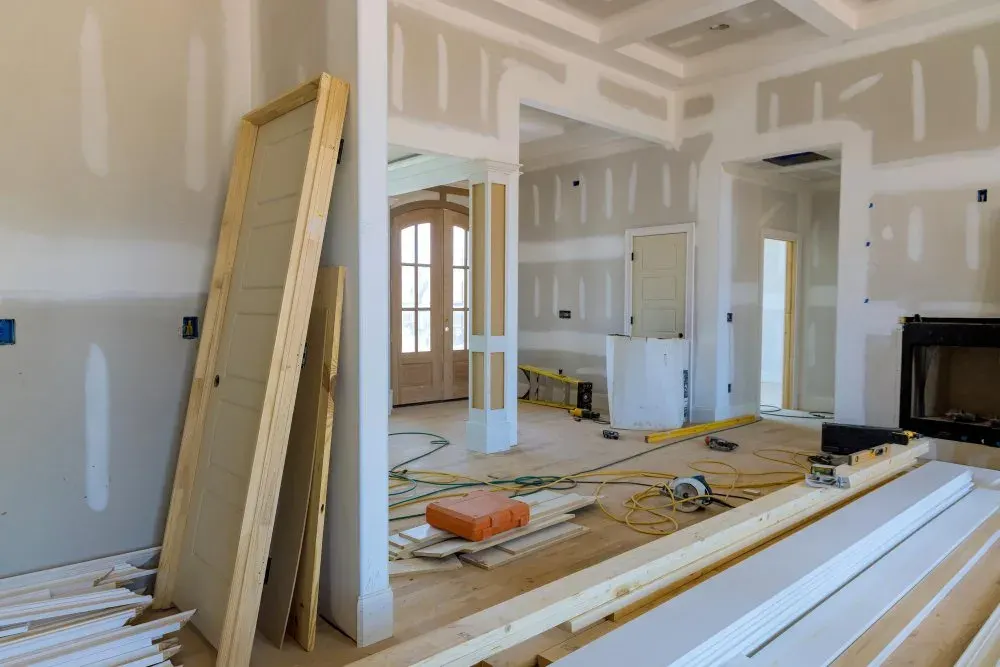
Walls in a renter-majority city
Drywall Repair for Rentals and Homes in College Park, GA
Roughly four of every five homes in College Park are rented, and most are not detached houses. So a cracked or stained wall often raises one question before any other: who owns this problem?
College Park at a Glance
- Location
- 8.6 miles southwest of central Atlanta (straight line)
- County
- Fulton County
- Population (2023 estimate)
- 13,867
- Housing units
- 7,160
- Median year homes were built
- 1972
- Owner-occupied homes
- 22%
- Detached single-family homes
- 30%
- Built before 1970
- 45%
- Built 2010 or later
- 7%
Sources: US Census Bureau 2023 Gazetteer, Vintage 2023 population estimates, and American Community Survey 2023 5-year estimates for the place. County is taken at the place’s center point; some communities extend into other counties.

A city where the person calling may not own the wall
Of College Park’s 7,160 housing units, Census estimates show just 22% are owner-occupied and 30% are detached single-family houses. Both numbers are far lower than nearby East Point, where 44% are owner-occupied and 52% are detached. That difference changes how a request for drywall repair College Park GA residents make tends to play out, since a damaged ceiling here may involve a tenant, a landlord, an association and a neighbor upstairs.
The age figures add a second layer. The median unit was built in 1972. About 37% date from 1970 to 1989, 31% from 1950 to 1969, and 14% from before 1950, with just 18% from 1990 onward. So walls in this city range from older lath-and-plaster possibilities to 1970s and 1980s gypsum board in multi-unit buildings, and the right repair differs across that range.
This page is organized by who is dealing with the damage, then by what the damage is telling you. Our drywall services are available for residential and commercial properties in the city, from a single damaged section to a larger repair.
If you rent
Before anyone cuts into anything, report the damage to the owner or manager in writing and take dated photos. Your lease and Georgia law decide who is responsible, and we can’t advise you on either. In practice, though, a written report matters because the visible stain is often the smaller problem.
Tell the owner what you have actually seen rather than what you suspect:
- Whether the spot is growing, and whether it feels soft or damp to a light touch
- Whether it gets worse after rain, or when a neighbor’s shower or washer runs
- Whether a seam, a nail line or a corner is the part that has moved
- Whether you can smell anything musty near it
Those details help whoever responds work out whether the cause is a roof, a pipe, a window or simple settling. Please don’t hang a picture over it and move on. The EPA’s guide to mold and moisture is direct on this: fix the water source, and dry wet materials quickly.
If you own the unit or the building
Landlords and small building owners usually care about three things: doing the repair once, matching the surrounding finish so it doesn’t draw the next tenant’s eye, and staying on the right side of paint rules.
Paint is the first check on older buildings
Most of the city’s housing predates 1990, and a large part predates 1978. The EPA’s renovation, repair and painting rule applies to paid work disturbing paint in homes built before that year, and the agency specifically says the rule applies to landlords renting out all or part of such a home. Cutting out a damaged section of wall disturbs paint. Find out the build date, and ask any firm you hire how it handles containment and cleanup.
Find the cause on your side of the wall, and the other side
In attached housing, a wet ceiling may originate in somebody else’s unit, and a damp wall may trace to a shared stack or a roof above several homes. Get access to the adjoining space before spending money on the finish. If the source is your own equipment, our plumbing services can address that first, and a roof leak needs handling before any board goes up.
Shared walls are not ordinary walls
Walls and ceilings separating units may be part of a building’s fire separation, and sometimes its sound control as well. A patch there may need more than a standard repair, and the requirements depend on the building and on code. Confirm with the building office before cutting through one, especially for a large opening or anything involving a penetration.
If you own a house in the historic district
The city center is part of the College Park Historic District, a 606-acre area on the National Register of Historic Places whose homes and bungalows date from 1882 to 1946. The same entry traces the city’s start to a railroad depot in 1890 and to its renaming from Manchester in 1896.
The Census figure for pre-1950 housing, 14%, gives a rough idea of how many homes might have walls older than drywall’s common use. If your house is one of them, look before you assume:
Plaster over lath
Tap the wall. Plaster feels hard and sounds solid, and an edge at a broken spot may show layers or wood strips behind. Loose plaster can often be re-secured and patched in sections, and tearing out a whole wall isn’t automatically the answer.
Drywall added later
Plenty of older houses have newer board in kitchens, baths or additions. That usually makes those rooms simpler, though the transition where new meets old is where cracks like to show up.
Trim and details
Baseboards, casings and picture rails in an older room may be difficult to replace. Removing them carefully and protecting them often matters as much as the patch does.
National Register listing doesn’t by itself tell you what a city requires of a private owner. Ask the city’s Building and Inspections department what review applies to your address, and whether the planned work needs a permit at all.
Reading the damage
Whoever you are, the shape of the problem gives useful clues. These are general patterns and not a diagnosis:
- A brown ring on the ceiling: usually water from above, whether roof, pipe or a unit upstairs. Find it before you fix it.
- A straight crack along a seam: tape has let go, which is common as a building moves over time and is typically a modest repair.
- A row of small round bumps: fasteners working loose from framing.
- Diagonal cracks at door and window corners: often normal movement, although a long, wide or growing one is worth having someone look at.
- A hole at doorknob height: the classic tenant-turnover patch, and a good moment to add a door stop.
- Sagging ceiling board: stop and investigate, since this can mean water weight or failed fasteners, and it shouldn’t be left.
Finish matters as much as the patch. Older walls may carry a hand-applied texture or many layers of paint, so a repair done in flat new compound may flash through once painted. Plan for interior painting of the whole wall, corner to corner, rather than a dab over the patch.
Airport noise and what a wall can and can’t do
College Park’s history is closely tied to Hartsfield-Jackson. The airport bought property designated as noise land in the 1970s and 1980s, the city and the FAA bought about 320 acres next to downtown from the 1980s into the early 2000s, and the city later repurchased them.
Will new drywall quiet a room? Modestly, it can help if gaps are closed, because sound travels through openings like poorly sealed outlets and penetrations. But windows, doors and vents frequently carry much of the noise, and one extra layer of board won’t solve a problem coming through those. If sound is your main complaint, look at the whole envelope, including general construction options for windows and doors, and ask the city or the airport whether any noise program currently applies to your address. We can’t speak to eligibility.
Offices, shops and tenant spaces
The drywall question looks different again in a commercial suite. Partition walls between tenants get moved whenever a lease changes hands, leaving behind screw holes, cut-outs from old data lines and patched door openings. A new occupant generally wants all of that to disappear under one even coat. Ceilings raise a separate question, since a tile grid hides water trouble that a hard ceiling would show.
Before a commercial repair starts, find three things: what the lease says about alterations, whether the wall is a rated separation between suites, and whether anything inside it will be moved. Moving an outlet or a sprinkler line turns a cosmetic job into trade work. Our commercial improvement page covers office, retail, restaurant and tenant work, and the city’s Building and Inspections department can tell you what its review requires for your suite.
Questions from College Park owners and renters
The city spans two counties. Does that change who handles my permit?
College Park lies across Fulton and Clayton counties, with most residents in Fulton. The city’s own Building and Inspections department is the place to ask first, whichever side of the line you’re on.
We're between tenants. Should we repair walls before or after painting and floors?
Before both. Sanding and patching make dust and mess, so drywall goes first, then paint, then new flooring.
Can you do a single patch in a building with many units?
Yes, handyman-sized repairs are part of what we do, along with larger renovations. Our handyman services page lists small jobs, and a free estimate spells out the scope first.
Is a drywall patch worth doing in a unit near the airport if we plan to renovate soon?
If the damage involves water, deal with the source now whatever your plans are. If it’s cosmetic and a larger renovation is close, you may reasonably fold it into that scope.
Sources for Local Facts

Let’s Build Something Great Together.
Ready to start your next construction or remodeling project? Tell us about your space and request a free estimate.