
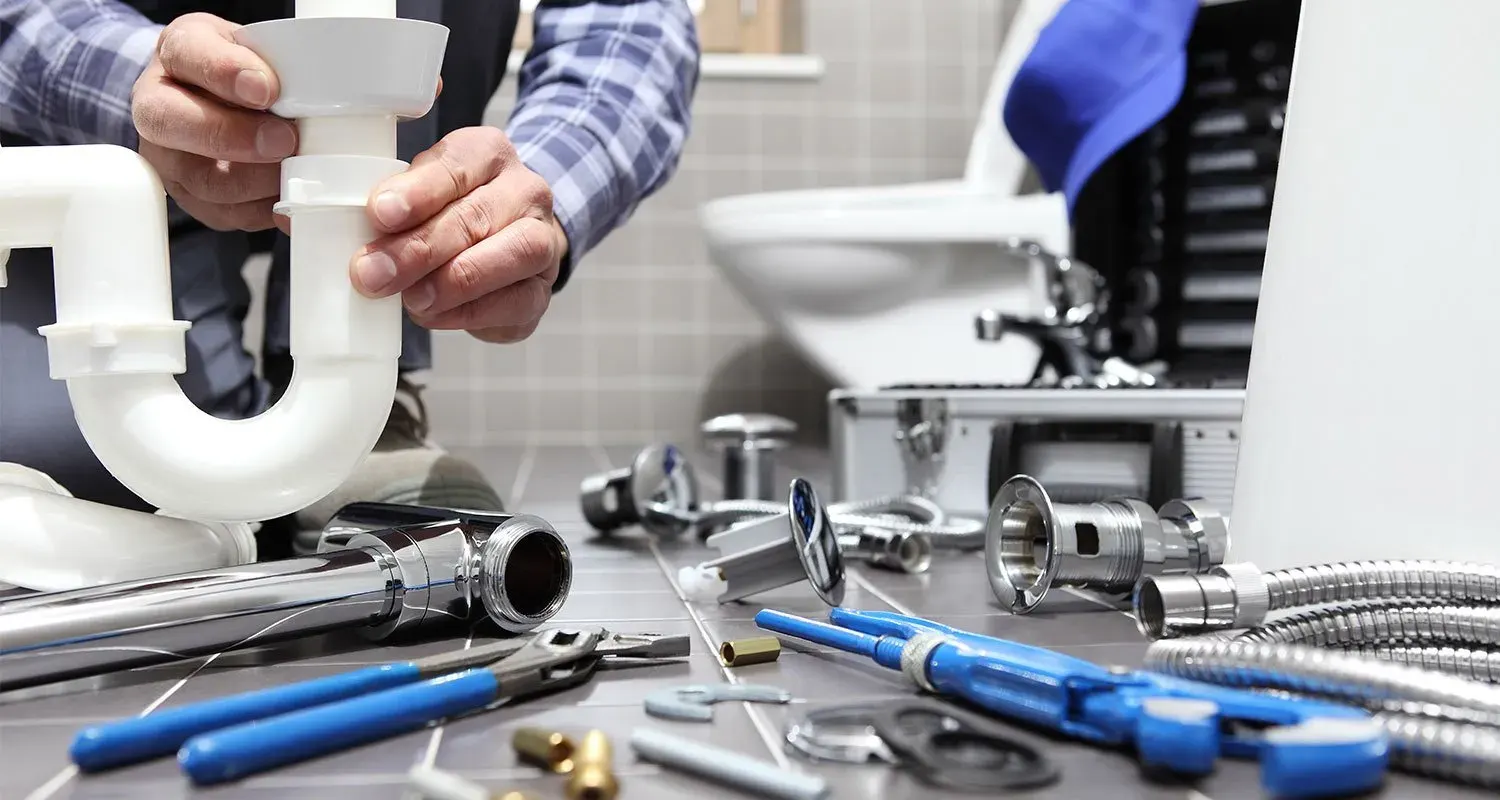
First-generation plumbing repairs
Plumbing for Flowery Branch, GA Homes
Flowery Branch grew quickly, and 43% of its homes date from 2010 or later. Plumbing here is usually young, which means a different set of problems than in older towns.
Flowery Branch at a Glance
- Location
- 39.7 miles northeast of central Atlanta (straight line)
- County
- Hall County
- Population (2023 estimate)
- 11,607
- Housing units
- 4,379
- Median year homes were built
- 2008
- Owner-occupied homes
- 64%
- Detached single-family homes
- 63%
- Built before 1970
- 8%
- Built 2010 or later
- 43%
Sources: US Census Bureau 2023 Gazetteer, Vintage 2023 population estimates, and American Community Survey 2023 5-year estimates for the place. County is taken at the place’s center point; some communities extend into other counties.

A new town on an old rail line
Flowery Branch has been around since 1874, when it took shape along the rail line linking Charlotte and Atlanta, and today it sits on the shore of Lake Lanier in Hall County, according to a general history. Its housing, though, is remarkably recent. That same source shows population rising from 1,806 in 2000 to 5,679 in 2010 and 9,391 in 2020. Census estimates put the median year built at 2008, with 43% of homes built since 2010 and another 45% from 1990 to 2009. Only about one home in eight is older than that.
So plumbing Flowery Branch GA homeowners deal with is seldom about corroded galvanized lines or a century-old sewer lateral. It is mostly about parts that have now reached their first replacement age, such as water heaters, toilet fill valves, supply lines, disposal units and faucet cartridges. It may also be about choices made during construction that nobody thought about until something leaked. Original fixtures in many of these houses were picked for price by the builder, and owners are now deciding what to upgrade rather than just what to fix.
The mix is also less uniform than you might assume. About 63% of homes are detached and 64% are owner-occupied, so a good number are townhomes or rentals. A leak in an attached unit may affect a neighbor, and it might raise the question of who is responsible, so it pays to know your association documents or lease.
Find a hidden leak with your water meter
EPA’s Fix a Leak Week page estimates that the average household’s leaks can waste more than 9,300 gallons a year, and that about 9% of homes have leaks of 50 gallons or more per day. A newer house is not exempt. You can run this check in an afternoon:
Stop all water use
Turn off taps, the dishwasher, the washer and any irrigation. Check that the ice maker is not filling.
Read the meter
Write down the reading and note the time. EPA suggests leaving the water off for two hours.
Read it again
If the number has moved, you probably have a leak somewhere. If it has not, your leak is likely small or only runs when something is in use.
Test each toilet
Add a few drops of food coloring to the tank. Color in the bowl within 10 minutes means the flapper is leaking. Flush soon afterward so it does not stain.
Check the bill in winter
EPA says that a family of four using more than 12,000 gallons per month in a colder month like January or February may have a serious leak. Irrigation should not be a factor at that time of year.
Look at the obvious places
Look under sinks, behind the washer, around the water heater pan and at any outdoor hose bib.
If the meter moves and you cannot find the cause, the leak may be in a slab, a wall or the line running from the meter. That is when a plumbing visit makes sense, since finding it may take specialized tools.
What tends to come due in a house this age
We have no local failure statistics, and nobody should pretend otherwise. What the age data gives is a reasonable basis for thinking about which parts have seen the most use. Here is a list for owners of a home built between about 2000 and 2020.
Water heater
Tank heaters don’t last forever, and many from the 2000s and early 2010s are candidates for checking. Rust at the base, a damp pan or rumbling sounds deserve attention. If it sits in an attic or upstairs closet, confirm the pan and its drain are in working order, because a failure there can reach ceilings below.
Toilet internals
Fill valves and flappers wear out after years of use. Replacing these parts is inexpensive, and it often quiets a toilet that runs at random. A loose toilet base deserves attention sooner, since it can let water reach the subfloor.
Supply hoses
Braided connectors at sinks, toilets and washing machines age out of sight. Washers are the classic trouble spot, so make sure the shut-off valves can be reached and turned.
Faucet cartridges
Builder faucets often begin to drip at the base or from the spout after a decade or more. A new cartridge may solve it, if parts are still available for that model.
Shower pans and valves
Tile showers from a building boom vary in quality. Staining on the ceiling beneath a shower or a musty closet next to it can suggest a failed pan or a bad seal, and that is a job for investigation rather than more caulk.
Drains and disposals
Slow kitchen drains are often a result of grease and food build-up. The city’s own Fats, Oils and Grease program is aimed at this exact problem on the sewer side.
When the same fixture keeps causing trouble, it can make sense to replace it as part of a bathroom update or kitchen project, while the surrounding walls and cabinets are already open.
City water, city sewer, and who owns what
The city’s Public Utilities department manages drinking water and wastewater, including treatment, storage and distribution, and runs a Water Quality Reclamation Facility along with the collection system. It also offers an educational program, a Water-wise Landscape Guide and a reminder to call 811 before digging. Conservation pricing is used to encourage lower water use, so a hidden leak can show up on the bill more clearly than you might expect. If your address is served some other way, for instance by a Hall County system or a private arrangement, the same checks still apply, though the contact will be different.
If you want to know what is in your water, read the city’s water quality reports before buying any treatment equipment. It is easy to buy a softener or filter to solve a problem that the report shows you do not have. And it is worth reading the F.O.G. Control Program page if your kitchen drains keep slowing down. Fats and grease washed down the sink are a problem for the home’s own lines and for the public system.
The city home page has also carried a notice on a statewide Level 1 drought response. Drought stages can change, so check current outdoor water rules before scheduling work such as irrigation repairs. In general, the boundary between what the utility maintains and what the homeowner maintains is typically at or near the meter, but confirm with Public Utilities where that line is for your property.
Slopes, a lake and what that means below ground
Living close to a large reservoir does not by itself cause plumbing trouble, and there is no general reason to think a home near the lake has worse pipes than one farther away. If your own lot slopes, though, or you have a lower level, a few things are worth watching.
- On lots that slope away from the street, the sewer connection may rely on careful grading or a pump. If a pump exists, find out where it is and what its alarm looks like.
- Lower-level bathrooms can sit close to or under the main drain’s height, which makes backups and ejector pumps relevant questions.
- High pressure can stress fixtures and hoses, and it can vary with elevation. A plumber can test it with a simple gauge at a hose bib.
- Irrigation systems, where a home has one, create extra connections and shut-offs. Find out where the backflow device and the shut-off valve are.
- Any home with a private well or a septic system, such as one on a rural lot outside city limits, has its own considerations, and county health authorities can tell you the rules.
The location of your main shut-off valve is the single most useful fact on this list. Find it now, test it, and show everyone in the house. If water ever begins running through a ceiling, that is the knowledge that limits the damage. EPA’s moisture guide advises drying water-damaged areas within 24 to 48 hours, and every minute of flow you prevent makes that easier.
Upgrades people actually consider
Since most fixtures here are not yet worn out, plumbing decisions in these homes are often about improvement, not failure. Reasonable ones include moving to a higher-efficiency water heater when the old one fails, replacing a builder-grade kitchen faucet and adding a pull-down sprayer, changing to WaterSense showerheads, and rerouting drains for a larger shower. Rough-ins left by the builder may also allow a lower-level bathroom without cutting through as much concrete, which ties into basement finishing.
We put the scope and pricing in writing before starting, and the estimate is free.
Permits, and when to stop and ask
The city’s Community Development department oversees zoning, building permits, plan review and building and site inspections, and it links an online application portal plus a Forms and Fee Schedule page. It lists a building permit clerk and a building inspector on staff. Ask that office whether a water heater change, a re-pipe or a new bathroom needs a permit, because this page cannot decide that for you. Addresses outside the city may fall to Hall County, even with a Flowery Branch mailing address.
For smaller items, handyman service may be enough, such as swapping a toilet fill valve. Anything concealed or involving gas is a job for a qualified plumber or technician. Owners close to Buford or Sugar Hill will want to check which jurisdiction applies. When you are ready, use the estimate form to describe what you are seeing.
Sources for Local Facts
- City of Flowery Branch: Public Utilities
- City of Flowery Branch: Community Development
- City of Flowery Branch: City website
- U.S. EPA WaterSense: Fix a Leak Week
- U.S. EPA WaterSense: Showerheads
- U.S. EPA: A Brief Guide to Mold, Moisture and Your Home
- Wikipedia: Flowery Branch, Georgia (general history)

Let’s Build Something Great Together.
Ready to start your next construction or remodeling project? Tell us about your space and request a free estimate.