Second and third roofs
Roofing for Homes in Auburn, GA
Most of Auburn's houses were built between 1970 and 2009, which means many are on their second roof or due for one. That timing, and what is under the old shingles, drives most of the decisions here.
Auburn at a Glance
- Location
- 36.7 miles northeast of central Atlanta (straight line)
- County
- Barrow County
- Population (2023 estimate)
- 9,688
- Housing units
- 2,946
- Median year homes were built
- 1992
- Owner-occupied homes
- 81%
- Detached single-family homes
- 79%
- Built before 1970
- 5%
- Built 2010 or later
- 10%
Sources: US Census Bureau 2023 Gazetteer, Vintage 2023 population estimates, and American Community Survey 2023 5-year estimates for the place. County is taken at the place’s center point; some communities extend into other counties.

Doing the arithmetic on your roof
Census data shows that about 47% of Auburn’s homes went up between 1990 and 2009 and another 37% between 1970 and 1989. The median year built is 1992. Only 10% date from 2010 or later. About 81% of homes are owner-occupied and about 79% are detached houses, so most roof decisions here fall to the person who lives under it.
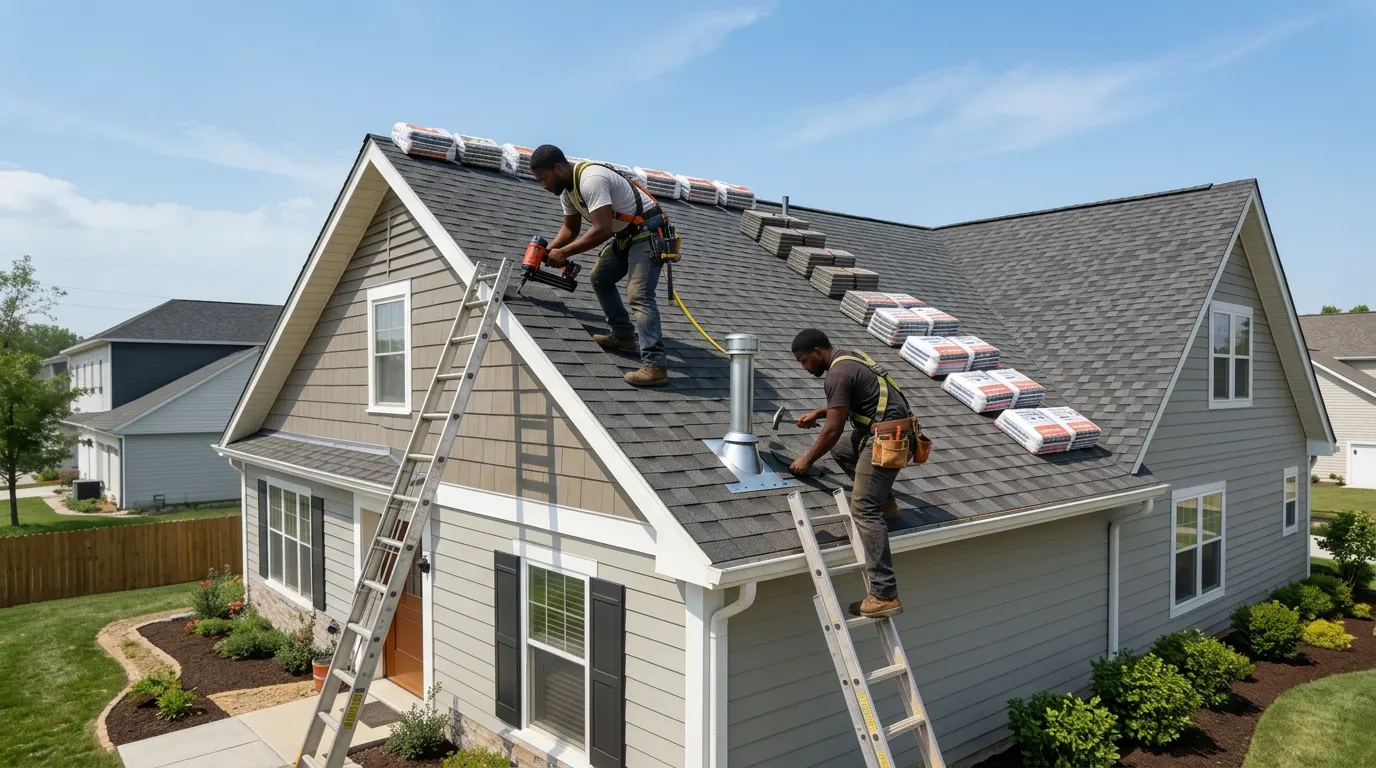
Asphalt shingle roofs commonly last somewhere in the range of 15 to 30 years, depending on the product, attic ventilation, sun exposure and how the roof was installed. A rough calculation follows. A 1992 house with its original roof would be well past that span by now, so if you haven’t replaced it, or don’t know whether a previous owner did, the first task for roofing Auburn GA owners face is finding out how old the roof actually is. A home built in the 1970s may be on its third roof, and might even have more than one layer of shingles. Those from the 2000s are probably approaching their first replacement.
Ways to pin down the age
- Check your closing paperwork and home inspection report, which often note the roof’s age or condition.
- Ask the previous owner, if you can reach them, or look for an old invoice among the house documents.
- Ask the city’s permit office whether a record exists for your address.
- Have an inspection done. A roofer can usually judge wear, and can often tell how many layers are present by looking at the edge.
Signs that matter, and signs that often don’t
Worth prompt attention
Water stains on a ceiling, daylight through the attic deck, missing shingles, lifted flashing at a chimney or wall, or a soft spot underfoot. A leak can travel along a rafter before showing up, so its stain may not sit directly below the opening.
Worth watching
Granules collecting in the gutters, curled or cupped shingle edges, cracked pipe boots, and rusted vents. On their own these point to age more than to a crisis, though they’re useful in deciding when to budget for a replacement.
Often cosmetic
Dark streaks from algae look bad but don’t, on their own, mean a roof is failing. Moss is a different matter, since it holds moisture, so keep branches trimmed back and let in sun and air where you can.
Often misread
A stain near an exterior wall might come from an overflowing gutter and not from the shingles. Clearing it up with gutter cleaning first can avoid an unnecessary repair. Bath fans venting into an attic can also dampen the deck from below.
If you’ve got an active leak, our roof leak repair page explains that service. If the roof is simply old, a new installation may be a better use of your money than a series of patches, though a well-placed repair can reasonably buy time on a roof with years still left in it. Ask for an honest comparison of both.
What to look at in the attic
The attic often explains why a roof wore out early, and a replacement offers a rare chance to deal with it. Go up on a mild day if you can do so safely, and use a flashlight.
- Dark or stained decking, particularly around vents and valleys, suggests a past or present leak.
- Rusty nail tips or frost-like dampness on the deck may mean moist indoor air is getting into the attic.
- Compressed or wet insulation points to where water has been landing.
- Soffit vents blocked by insulation restrict the airflow that keeps a roof deck cooler and drier.
- Bath or dryer vents ending in the attic instead of outdoors put moisture right where you don’t want it.
- Ducts and an air handler in the attic may need protecting during the work, and a dripping condensate pan can look like a roof leak.
The EPA’s moisture guidance is a good reference for the wider point: find the water source, and clean and dry whatever has gotten wet. If replacing the roof also uncovers decking damage, ask in advance how rotted boards will be priced, as you can’t fully see their condition until the old shingles come off. A clear scope written before work starts should deal with that.
Wind and falling trees
Tornadoes and severe storms are part of life in north Georgia. A nearby example was reported by Fox 5 Atlanta in March 2017, citing National Weather Service survey crews: a short-lived EF-0 tornado with winds of about 85 mph touched down just east of the Barrow County Airport, snapping or uprooting several large trees. That event wasn’t in Auburn itself, and we’re not suggesting Auburn roofs were affected. We mention it because it shows what even a low-rated tornado can do with mature trees in this county.
For a roof, the lesson has more to do with what’s overhead than with shingle wind ratings alone. Take a look at any large limbs reaching out over the house. Trees that lean or show damage should get an arborist’s opinion. The city’s Building Permits page lists a tree permit application among its forms, so ask whether removal on your lot needs one.
After a storm
Stay safe first
Don’t climb onto a wet or damaged roof. Stay clear of downed lines and hanging limbs, and walk the yard only once it’s clearly safe.
Record the damage
Take photos from the ground, with dates, of the roof, gutters, siding and any fallen limbs. Inside, photograph any new stains.
Limit further harm
If water is coming in, move belongings and catch what you can. Contact your insurer about what to document and how soon.
Be careful with door knockers
After storms, unfamiliar roofers sometimes go door to door. Take your time, get any proposal in writing, and read before signing anything.
Permit questions: start with the city’s re-roof guide
The City of Auburn’s Building Inspections page offers a downloadable 2018 IRC Building Guide for residential re-roofing, which tells you the city has specific material for this kind of work. The main text doesn’t state whether a re-roof needs a permit, and neither does the permits page, so we’re not going to tell you either way. The same inspections page tells owners to call the Community Development Department before starting a project to find out whether a permit is required. Neighboring places differ on this, so don’t rely on what a friend in another town was told.
According to those pages, the city contracts with SAFEbuilt for plan reviews and building inspections, and the permit page describes processing times of five to seven business days. Electrical, plumbing, HVAC and low-voltage work need separate permits from whoever does that work, which matters if a roof project also moves a vent, a solar array or attic equipment.
One boundary is worth noting. The Census places the city’s center point in Barrow County, and the permit page refers to both the Barrow and Gwinnett County fire marshals and health departments for commercial projects. The city’s history page also describes the area’s roots in eastern Gwinnett. If your address may be outside the city limits, confirm your jurisdiction, because the county will run its own process.
Comparing two roof proposals
Shingle brand and color tend to dominate the conversation, yet the differences that matter most usually sit lower on the page. Before you compare totals, check that both proposals cover the same work.
- Whether the old shingles come off or a new layer goes over them, and how many layers are there now.
- How damaged decking will be identified and priced once the roof is open.
- What underlayment goes down, and what happens at valleys, eaves and walls.
- Whether flashing, pipe boots and vents are being replaced or reused.
- What attic ventilation changes, if any, are included.
- Who cleans up, including nails in the yard, and how gutters and plantings will be protected.
If one bid leaves several of these unstated, ask about them directly. The answer may change the comparison.
Older town, newer roofs
Auburn grew up around the railroad. The city’s account says the line was surveyed and the town platted in 1891, the first train arrived that October, and incorporation followed in 1892. The Census counts only around 5% of current homes from before 1970, so these older buildings are the exception. If you own one, keep two extra points in mind: decking may be old board-style sheathing that deserves a careful look, and paint on old trim may contain lead. The EPA’s renovation rule applies to paid work disturbing paint in homes built before 1978, which also includes the early part of that large 1970-to-1989 group.
A new roof is also a good time to think about what sits next to it. Peeling fascia, tired siding and old vents can be addressed together with fewer trips up a ladder. Water stains inside might call for drywall repair and repainting once the leak is stopped, and owners planning an addition should ask whether it makes sense to time the new roofline and the re-roof together.
We serve Auburn for roofing services including repair, replacement, inspection and new installation, and for the remodeling work that often follows. Estimates are free. Our service area also covers neighboring Dacula and Lawrenceville, where the permit steps differ from those described here.
Sources for Local Facts
Let’s Build Something Great Together.
Ready to start your next construction or remodeling project? Tell us about your space and request a free estimate.