
First-generation systems
HVAC Services for Newer Homes in Grayson, GA
About 63% of Grayson's homes went up in 2010 or later. Many households are living with the heating and cooling equipment the builder chose, and they will be the first owners to deal with its aging.
Grayson at a Glance
- Location
- 26.5 miles east of central Atlanta (straight line)
- County
- Gwinnett County
- Population (2023 estimate)
- 4,975
- Housing units
- 1,223
- Median year homes were built
- 2012
- Owner-occupied homes
- 90%
- Detached single-family homes
- 95%
- Built before 1970
- 2%
- Built 2010 or later
- 63%
Sources: US Census Bureau 2023 Gazetteer, Vintage 2023 population estimates, and American Community Survey 2023 5-year estimates for the place. County is taken at the place’s center point; some communities extend into other counties.

A very young housing stock in a very old town
Grayson’s post office opened in 1881 under the name Trip, and the town was incorporated as Berkeley in 1901 before taking its current name in 1902, according to the city’s history page. The railroad linking Lawrenceville and Loganville served it from 1898 until 1932. The Kennerly-Cox House on Rosebud Road, built in the late 1880s or 1890s, was bought by the city in 2001.
Yet almost none of that age shows up in the housing data. The median home here dates from 2012. Census estimates show 63% of homes built in 2010 or later and 31% from 1990 to 2009, leaving about 7% from before 1990. With 95% detached houses and about 90% owner-occupied, Grayson is about as uniform as a place gets in this part of Gwinnett County.
A housing stock like this produces a particular kind of question. Few households here are thinking about replacing old galvanized pipe or peeling lead paint. They are asking why the upstairs is warm, why a condensate drain backed up, and whether a 12-year-old system is worth repairing. Those are the questions behind most searches for HVAC services Grayson GA homeowners make, so this page sticks to them.
What the first 10 to 15 years usually reveal
Builder-installed systems can run for many years, but first owners often start to find the limits of the original setup at around this age. These are the common things to look at, none of which is specific to any one builder or neighborhood.
Uneven floors
Two-story houses commonly run hot upstairs. The cause may be duct sizing, airflow balance, zoning, attic heat or a combination. Closing vents downstairs seldom solves it and can make airflow worse.
Humidity that lingers
The EPA’s moisture guide recommends keeping indoor humidity below 60%, ideally between 30% and 50%. An inexpensive humidity meter will tell you where your house stands during a muggy stretch.
Condensate trouble
Air conditioners pull a lot of water out of Georgia air. The same EPA guide says to keep drip pans clean and drain lines unobstructed. Attic equipment makes this especially important, because a blocked line can stain a ceiling.
Dirty coils and tired filters
Outdoor units collect grass, pollen and leaves. Indoor coils collect whatever gets past a filter. Both reduce performance gradually enough that many owners don’t notice until summer.
Controls and thermostats
A thermostat from the original build may be perfectly fine, or it may be the reason a system runs oddly. Rule out the simple causes before discussing bigger equipment.
Duct connections
Attic ducts get bumped by anyone storing boxes or running cable. A disconnected or crushed run can make one room feel broken while the equipment itself runs properly.
Our HVAC services page outlines the heating and cooling work we offer. We serve Grayson for service calls and for projects where HVAC is part of a larger plan.
Repair or replace: thinking it through before something fails
No fixed age decides this. A system’s condition, how it has been maintained, its size relative to the home, and the cost of the repair all matter more than the birthday on the data plate. It helps to gather a few things while nothing is wrong, so that a hot weekend doesn’t force a rushed choice.
Find the paperwork
Locate the closing packet, the equipment model numbers and any coverage documents from the builder or manufacturer. Check whether anything needs to be registered or still applies.
Record what you have
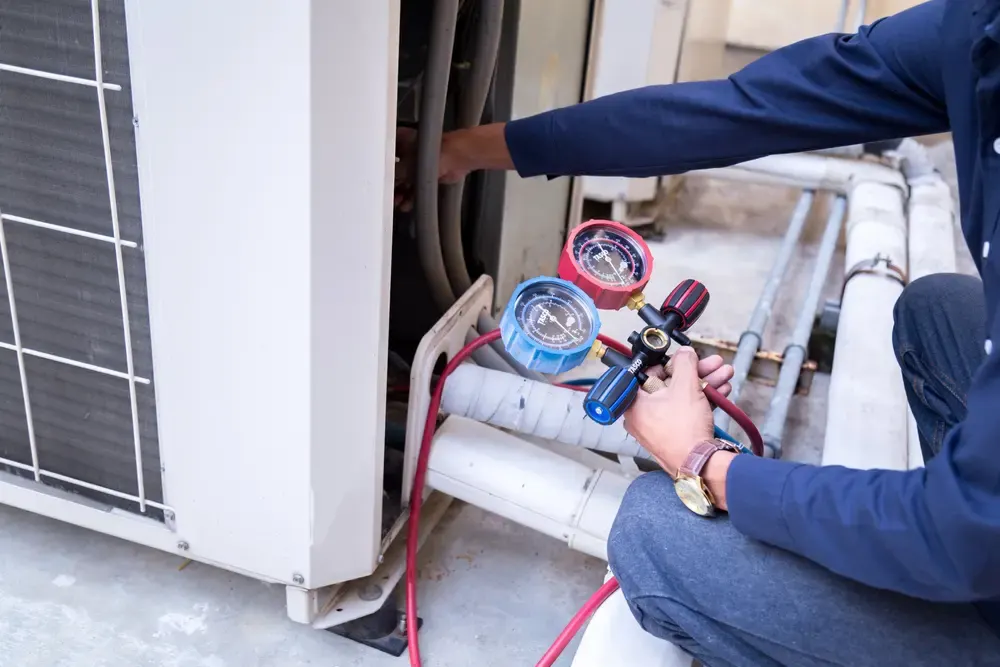
Photograph the labels on the outdoor unit and the indoor air handler or furnace. Note the refrigerant type shown on the label, since rules for new equipment changed in recent years and it is a fair question to ask about parts and servicing on older units.
Keep a simple log
Write down service dates, repairs and odd behavior. A pattern of the same repair is far more useful than a vague memory when you are comparing options.
Ask for reasoning, not just a price
A useful recommendation explains what failed, why, and what the options are, including repair. If a replacement is proposed, ask how the size was decided, and whether ductwork was looked at or only assumed to be fine.
Check the permit status
Ask whether the job calls for a city permit before work begins, and who will pull it.
How finishing space changes the load
Newer homes are often the ones where owners start adding rooms inside the existing shell. A finished bonus room, a finished basement or an attic conversion all change how much air a house needs to move and where. This is the point at which many first owners learn their system was sized and ducted for the house as it was built.
- Basements bring humidity into the equation, so talk about moisture control and supply air before framing begins.
- Attic conversions need a plan for the equipment and ducts that may already live up there.
- Bonus rooms over garages are a common comfort complaint and may need attention to both air sealing and supply.
- Additions raise the question of whether to extend the existing system or serve the new space separately.
- A kitchen remodel with a stronger range hood may affect how the house breathes, so mention it to whoever is advising you on ventilation.
Bringing HVAC into the conversation early, along with the framing and electrical, tends to prevent the kind of soffit or chase that gets added late and looks like an afterthought. We can include it in one scope of work, with pricing laid out before anything starts.
Simple upkeep for homeowners
Most of the routine care for a young system is not complicated. Follow the manufacturer’s guidance as a first rule, and treat the following as sensible habits.
- Check the filter monthly during heavy use until you learn how quickly yours loads up, then replace it on that rhythm.
- Keep two feet or so of clear space around the outdoor unit, and rinse off grass clippings and leaf debris with the power off.
- Don’t let mulch or shrubs creep up against the condenser.
- Learn where the condensate line ends outside, and glance at it during hot weather to see that it is dripping.
- Keep attic storage clear of ducts and of the air handler’s service access.
- Look at the ceiling beneath any attic unit for early staining.
A related detail: clogged gutters and air conditioner condensate can both put extra water at the base of a house. A University of Georgia article advises making sure this runoff drains away from the foundation, and it notes that clay soil stays wet for a long time. Check where your condensate discharges. Should you need it, we also offer plumbing for related drain and water line work.
Describing a comfort problem so the visit is useful
A note that says the AC isn’t working well gives a technician little to go on. A few days of simple observation can narrow things down considerably, and may save a return trip.
- Which rooms are affected, on which floor, and at what time of day? A west-facing bedroom that overheats only in late afternoon points somewhere different from a whole floor that never cools.
- What does the thermostat read compared with a separate thermometer placed in the problem room?
- Does the system run constantly, short-cycle on and off, or fail to start at all?
- Has the indoor humidity changed? Note the reading if you have a meter.
- Is there any new noise, odor, or water near the indoor unit?
- Has anything changed recently, such as new attic insulation, new windows, a finished room or a new filter type? High-restriction filters can reduce airflow on some systems.
Heating deserves the same attention, even though Georgia winters are mild enough that a weak system can go unnoticed for years. Run the heat for a while on the first cool day of autumn instead of waiting for a hard freeze. Odd smells during the first few minutes are often just dust, though anything persistent, and any concern about gas equipment, should be checked by a qualified technician. If a carbon monoxide alarm sounds, leave the house and call for help.
Grayson questions
Who issues building permits inside Grayson's city limits?
The city’s forms page offers a combined Building Permit and Zoning Application through an online portal, alongside a Unified Fee Schedule. Call City Hall to ask which HVAC changes require a permit. The Planning and Zoning page lists City Hall contacts.
My address says Grayson, but am I in the city?
Not necessarily, and it is worth checking. The city’s page describes its own portal, and addresses beyond the limits would fall to Gwinnett County. Confirm your parcel before assuming which office applies.
My house is only about ten years old. Should I already be worried?
Worried is too strong a word. Yearly attention, a clean filter and a free-flowing drain go a long way, and a decade-old system may have plenty of life left. It is simply a good age to learn what you have and keep records, so that later decisions are calm ones.
Does the Kennerly-Cox era matter to my HVAC at all?
Not unless you own one of the town’s few older buildings. Only around 7% of local homes date from before 1990. Older houses have different concerns, more like those covered on our pages for Snellville or Lawrenceville.
Sources for Local Facts
Let’s Build Something Great Together.
Ready to start your next construction or remodeling project? Tell us about your space and request a free estimate.