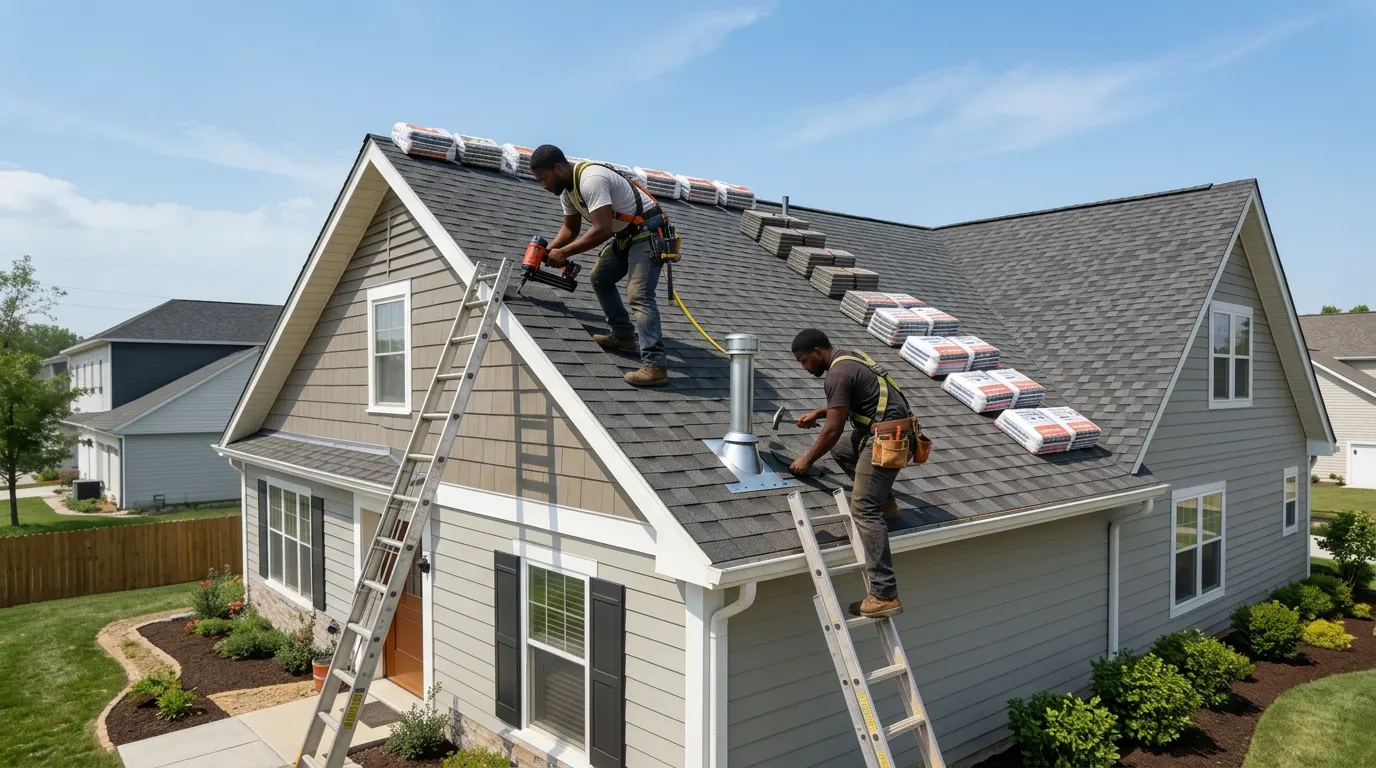
Older decks under newer shingles
Roofing in Doraville, GA, for Postwar Homes
Doraville grew up around a postwar auto plant, and very little of its housing is recent. The shingles on a house here may be recent, but what lies under them often is not.
Doraville at a Glance
- Location
- 12.9 miles northeast of central Atlanta (straight line)
- County
- DeKalb County
- Population (2023 estimate)
- 10,780
- Housing units
- 3,877
- Median year homes were built
- 1972
- Owner-occupied homes
- 57%
- Detached single-family homes
- 61%
- Built before 1970
- 45%
- Built 2010 or later
- 4%
Sources: US Census Bureau 2023 Gazetteer, Vintage 2023 population estimates, and American Community Survey 2023 5-year estimates for the place. County is taken at the place’s center point; some communities extend into other counties.

The plant is gone, but its housing boom still shapes the roofline
Doraville was incorporated in 1871 and remained a small farm town until General Motors chose it for a new assembly plant after World War II. The town grew through the late 1940s and 1950s as a result. The plant closed in 2009 and was demolished in 2015, as this general history records, but the houses from those years are still the core of the city.
The Census numbers make that plain. Some 41% of Doraville’s homes were built from 1950 to 1969, and another 36% from 1970 to 1989. Only 4% have been built since 2010. The median home dates to 1972, 61% are detached and 57% are owner-occupied. In other words, roofing Doraville GA homeowners deal with is mostly replacement work on structures that have likely been re-covered before, not first-time repairs on new construction.
That has a practical upshot. On a house this age, the shingle is often the newest and least interesting layer. The decisions that decide how long the next roof lasts are underneath and around it.
What age does to the parts under the shingles
None of these are certain in any given house, as earlier owners may have already dealt with them. They are just the first things to ask about on a roof of this vintage.
Decking
Many older roofs were sheathed in boards or early panel products. Past leaks, repeat nailing from earlier tear-offs and sagging between rafters all show up only when the old layers are off. Ask how rotten or damaged decking will be handled and priced.
Layers
Some postwar houses have had one roof nailed over another. Ask how many layers are up there before comparing bids, because tear-off changes the work and may reveal more of the deck.
Flashing
Chimneys, wall transitions and vent pipes are the classic leak points. Reusing old flashing under new shingles is a shortcut worth asking about. Old lead vent boots and pipe collars are simple items to change while the roof is open.
Eaves and soffits
UGA Extension’s moisture checklist warns against blocked soffits, because they supply attic airflow. A low-slope roof with short overhangs can leave little room for air to get through.
Attic ventilation
Bath fans and dryer ducts sometimes dump into the attic of an older house. Those exhausts should reach outdoors. Fix that during the roof job, or the moisture will keep working on your new deck from below.
If the house was built before 1978, EPA’s lead renovation rule applies to paid work that disturbs painted surfaces, which can include old fascia, soffits and trim touched during a roof replacement. Roof tear-off itself is a separate issue, but the painted wood around it deserves a question.
Your own walk-around, from the ground
You don’t have to go up on the roof to learn most of what you need, and we would rather you didn’t. From the yard and the attic hatch, here’s a sensible list, partly drawn from the UGA checklist above:
- Missing, curling or cracked shingles, and any bare or dark patches on slopes facing the sun
- Sagging ridge lines or wavy planes that could mean problems in the structure, not just the surface
- Stains on ceilings near chimneys and bathrooms, and rust on nail tips in the attic
- Daylight showing around vent pipes or at the ridge when you look up from inside the attic
- Granules building up at the downspout outlets, which may point to a worn surface
- Peeling paint or soft spots along the fascia behind the gutters
- Gutters holding water or debris, and downspouts emptying near the foundation
- Branches resting on or hanging over the roof, or a mature tree leaning toward it
Regular gutter cleaning helps with the last few, and water backing up under the eaves is often misread as a shingle failure. EPA’s general advice to clean and repair gutters regularly and fix leaks promptly applies well here. If something on this list looks urgent, a targeted roof leak repair may buy time while you plan the larger job. If several items are present on an older roof, get a replacement price alongside the repair price so you can compare the two honestly.
Weighing a repair against a full replacement
Neither choice is automatically the thrifty one. A repair tends to make sense when the damage is limited to one spot, such as a single vent collar, a lifted section after a storm or a chimney flashing, and the shingles elsewhere still lie flat and hold their granules. Replacement starts to win out when leaks show up in more than one place, when the surface is curling across whole slopes, when a roof has already been patched several times, or when you plan to stay long enough to get the benefit. Old shingles can also be too brittle to lift for a clean repair, which limits the options. Ask anyone quoting the work to show you photos of what they saw and to explain why they are recommending what they recommend.
Storm water and trees around the house
Heavy rain has a record here. The National Weather Service’s account of the September 2009 floods lists the North Fork of Peachtree Creek at Doraville cresting at 12.93 feet on September 21, against a flood stage of 12 feet. A flood on a creek is not a roof problem, but it is a reminder of what a roof and gutter system must shed during long-lasting storms. A short rain finds few weaknesses, whereas days of steady rain find every worn flashing and clogged downspout. Where water goes after leaving the roof also matters, particularly on sloped lots or those near a drainage channel.
Trees are the other part of the picture. The city’s Community Development Department lists the tree canopy among its responsibilities, alongside stormwater design management, and its permit page includes both a Tree Removal Permit Application and an Emergency Tree Removal Request. So don’t assume you can take down a tree threatening the roof without contacting the city. A limb trim may be a simpler answer, but ask if you are unsure which category your work is in.
A replacement is also a rare chance to deal with the attic, as the crew and the deck are already exposed. Check the insulation depth while you are at it, and make sure it does not block the soffit vents. On houses wired between 1965 and the mid-1970s, the Consumer Product Safety Commission warns that aluminum branch circuits can overheat at their connections, and attic junction boxes are one place an electrician may be able to identify it. If a kitchen or attic project is coming within a few years, it’s also worth asking whether any vent, skylight or roof penetration should be planned now, so that new shingles don’t have to be cut open later. Tell your neighbors before tear-off day, move vehicles clear of the driveway, and take fragile items down from walls in upper rooms, since hammering can shake them loose.
Permits and questions specific to Doraville
The Community Development Department handles building construction and permitting, with a Building Official and a deputy listed on its page. Applications go through the city’s online portal, every permit requires a notarized homeowner or property owner affidavit, and the page says first reviews and resubmittals take about 10 business days.
One honest gap: the city’s permit page does not mention roofing specifically. It links a residential guide called What Needs a Permit, which is worth reading first. So before a re-roof, contact the department at (770) 451-8745 or permits@doravillega.us and ask whether your particular job needs one, particularly if decking or structure will be replaced.
My house is from the 1960s and has never had a major problem. Should I replace the roof anyway?
Not simply because of the age of the house. What counts is the age of the current covering, the condition of the deck and the ventilation. An inspection is a reasonable starting point, and our roofing service includes inspection, repair and replacement.
I'm also thinking about re-siding. Does it make sense to do both at once?
Often, yes. The two trades meet at the eaves and wall flashing, so coordinating them can avoid leaving a poor joint. Siding and exterior work is something we offer as well, and doing it in sequence makes sense on a house where both are near the end of their life.
Is a detached garage or carport treated separately?
The city’s permit page points to separate guidance on carports, garages and sheds, so ask how your structure is classed. It is also a good moment to look at those older roofs, which often get less attention than the house.
I rent out the house. Does that change anything?
It can. EPA’s lead rules apply to rental homes built before 1978, and tenants will need notice about access and noise. Paid paint-disturbing work counts even when the house sits empty between tenants.
When you are ready to get pricing for a new roof installation, ask for a written scope that spells out layers, decking, flashing and ventilation. Those four lines will tell you more about two competing bids than the shingle brand. We also serve Chamblee and Tucker, and you can request a free estimate for any of this work.
Sources for Local Facts
- City of Doraville: Community Development
- City of Doraville: Permits
- National Weather Service Peachtree City: Epic Floods of 2009
- University of Georgia Extension: Mold and Moisture Home Inspection Checklist
- U.S. Consumer Product Safety Commission: Repairing Aluminum Wiring (Publication 516)
- EPA: Lead Renovation, Repair and Painting Program
- EPA: A Brief Guide to Mold, Moisture and Your Home
- Wikipedia: Doraville, Georgia (general history)
Let’s Build Something Great Together.
Ready to start your next construction or remodeling project? Tell us about your space and request a free estimate.