
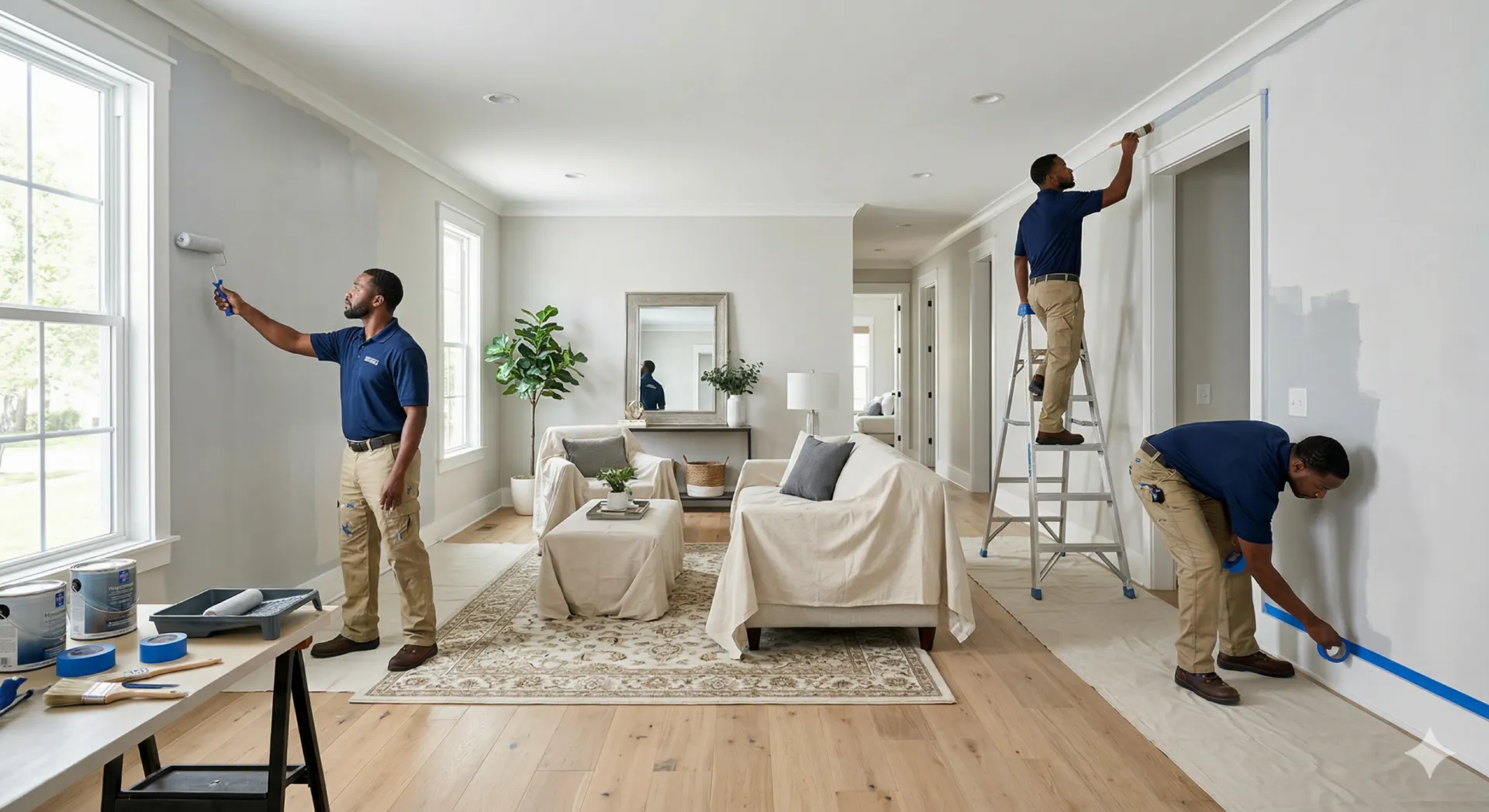
Paint, prep and people at home
Interior Painting for Dunwoody, GA Rentals and Owner Homes
Nearly half of Dunwoody's homes are rented and most are not detached houses, so an interior repaint here usually happens around tenants, neighbors or a move-out date. We serve Dunwoody with interior painting and the drywall and trim repairs that come before it.
Dunwoody at a Glance
- Location
- 14.0 miles north of central Atlanta (straight line)
- County
- DeKalb County
- Population (2023 estimate)
- 51,713
- Housing units
- 23,588
- Median year homes were built
- 1984
- Owner-occupied homes
- 54%
- Detached single-family homes
- 43%
- Built before 1970
- 15%
- Built 2010 or later
- 6%
Sources: US Census Bureau 2023 Gazetteer, Vintage 2023 population estimates, and American Community Survey 2023 5-year estimates for the place. County is taken at the place’s center point; some communities extend into other counties.

Who is living in the room being painted?
That sounds like an odd place to begin a page on paint, but in Dunwoody it is the practical one. Census figures show about 54% of occupied homes are owned, which means roughly 46% are rented. Only about 43% of the 23,588 housing units are detached single-family houses. The rest are attached homes, condos and apartments. The city also holds Perimeter Center, the large job and retail district that grew up around Perimeter Mall after the land for it was sold in 1971, so plenty of residents need a home that keeps working on a weekday.
A painter in an empty house can spread out. A painter in an occupied third-floor condo has to think about elevator access, hallway rules, where the ladders go at night, and who is working from the bedroom. A landlord between tenants has a move-in date to plan around. An owner in a detached house may just want every room done in a sensible order. Those are three different jobs, even when the can of paint is identical.
Where the housing dates matter
The area stayed rural until suburban building began in the 1960s, and the city became a municipality in December 2008. The Census data fits that account. About 44% of homes date from 1970 to 1989, 35% from 1990 to 2009, 14% from 1950 to 1969, and a mere 1% from earlier. Only 6% were built in 2010 or later. The median year built is 1984.
Read together, those shares suggest something simple: very few Dunwoody homes are new, and a large group sit on either side of a key federal date. Any home built before 1978 falls under a specific rule on painted surfaces, explained in the next section. Homes from 1978 onward are outside that rule but are often on their third or fourth coat, and years of semi-gloss over flat over primer can bring adhesion problems of their own.
For an owner, the takeaway is to find the actual year on your deed or tax record. The Census gives neighborhoods a pattern. Only your property record tells you where your own home lands.
Before 1978: the rule landlords should know
The EPA’s Renovation, Repair and Painting Program applies to anyone paid to disturb painted surfaces in housing or child-occupied facilities built before 1978. Firms must hold EPA’s firm credential and use workers trained in lead-safe practices. According to the agency, about three-quarters of US homes built before 1978 still contain some lead-based paint.
Owners doing work on their own homes are generally exempt, but that exemption has limits. It goes away if you rent out all or part of the home, run a childcare center there, or renovate and sell homes for profit. Landlords and property management companies have to comply when work disturbs paint in a pre-1978 rental. With about 15% of Dunwoody’s homes older than 1970, and more from the early and mid 1970s, plenty of local rentals and condos could be covered.
- Check the construction year of the building, not the year of your last renovation.
- If the date is before 1978, ask any painter how they will handle scraping and sanding before you get into colors.
- Remember that sanding a window sill or door frame is where trouble tends to begin, as friction surfaces generate dust.
- Keep children and pregnant household members away from the work area while dust is being handled, and ask how cleanup will be checked.
The older walls and ceilings carry one more item. The Consumer Product Safety Commission notes that asbestos may be present in textured paint and joint patching compounds, and that their use was banned in 1977. Scraping or sanding those surfaces can release fibers. If a pre-1978 ceiling needs more than a coat of paint, have it tested first. Material in good condition is usually left alone.
Interior painting Dunwoody GA owners and managers can plan by situation
Tenant turnover
A vacant unit is the easiest time for a repaint and for the small repairs that collect during a lease: anchor holes, door dings, scuffed baseboards. Choose a washable finish in traffic areas and keep a record of the colors used, so later touch-ups match. Agree on who removes wall-mounted items left behind.
Occupied condo
Check your association’s rules for working hours, elevator reservation and insurance paperwork. Corridors and exterior-facing doors may be common elements with an assigned color. Inside the unit, plan one room at a time so that furniture has somewhere to go and someone can still work at a desk.
Townhome stairwell
Tall stair walls are the awkward part of many attached homes. They call for planks or a stair ladder, and they show roller marks more than ordinary walls do. Paint them with the upper hall so the color breaks fall in a sensible place.
Detached house
With a larger floor area, sequencing matters more. Many owners work from the top floor down or tackle shared living areas during a vacation. Consider the ceilings and trim too; they are often the surfaces that make a room look tired.
Whichever one fits, an occupied home benefits from a plain written list of rooms, surfaces and coats. Twelve25 provides a detailed scope with clear pricing before work starts, and that list is really what you are comparing when you read two proposals side by side.
Air, smell and a home that stays lived in
Paint fumes are a bigger issue when you live in a sealed condo with few operable windows. The EPA’s guidance on volatile organic compounds notes that paints contain organic solvents that release these compounds while in use and, to some degree, while stored. It recommends as much ventilation as possible during painting, opening windows to bring in outdoor air when a label calls for it, and buying only what you will use soon.
In practice that leads to a few habits. Low-odor products help but do not remove the need for fresh air. Keep bedroom doors closed during work in nearby rooms. Run a fan pointed outward at a window where there is one. Tell the household, or the tenant, which rooms will be off limits and for how long. Anyone with asthma or a new baby should talk through the plan in advance, and may want to spend part of the day elsewhere. Leftover cans should not sit open in a closet; seal them, label them with the room, and store them as the label directs.
Prep is where a 1980s wall needs attention
Most of what makes a repaint last happens before the first coat. On walls of this age, these are the conditions that deserve a close look:
Find the moisture first
Stains on a ceiling under a bathroom or a stain beneath a window have a cause. Paint over it and the mark usually comes back. If there is a leak, it should be fixed by a plumber or roofer before anyone reaches for a brush.
Repair what is loose
Nail pops, cracked joints and old anchors need filling and sanding. Larger failures may call for professional drywall repair, with the seam feathered wide enough to disappear once the light rakes across it.
Test old finishes
Older oil-based trim can reject latex without the right primer. A simple rub test with denatured alcohol or a small sample area shows whether the coat will stick.
Prime with purpose
Spot-prime patches and stains. Use a full coat when moving between very dark and very light colors, or when the sheen differs greatly from one coat to the next.
Sheen is worth a moment too. Flat hides wall flaws but marks more easily, which matters in a busy rental. Eggshell and satin clean up better. Trim and doors usually get semi-gloss. In a condo where one tenant follows another every few years, consistency matters more than fashion, because the next touch-up will be easier if every room uses the same product.
Permits, and work that grows from a paint job
A simple repaint is not usually the kind of job that draws a permit, but that changes if walls are moved, wiring is added or a room is remodeled. Dunwoody’s Community Development department handles this, so check its permits and inspections pages or call the office for current rules. The Atlanta Journal-Constitution reported in 2019 that the city had moved to online permit processing, and the system may have changed since. Condo owners should also ask the association, since a board’s approval is separate from the city’s.
Fresh paint often exposes other things. A new color can make a worn floor look worse, and an empty rental is a convenient time to handle several items at once. These are the related services people tend to pair with a repaint:
- Interior painting for walls, ceilings, trim and doors
- New flooring, which is often scheduled after the paint is dry to reduce the risk of damage
- Small handyman repairs such as sticking doors or loose hardware
- A bathroom refresh when the room has reached the point where paint alone will not help
If you own property on the Sandy Springs side of Perimeter as well, the same questions apply there, though the permit office is different. For a look at your rooms and a written proposal, request a free estimate.
Sources for Local Facts
Let’s Build Something Great Together.
Ready to start your next construction or remodeling project? Tell us about your space and request a free estimate.