
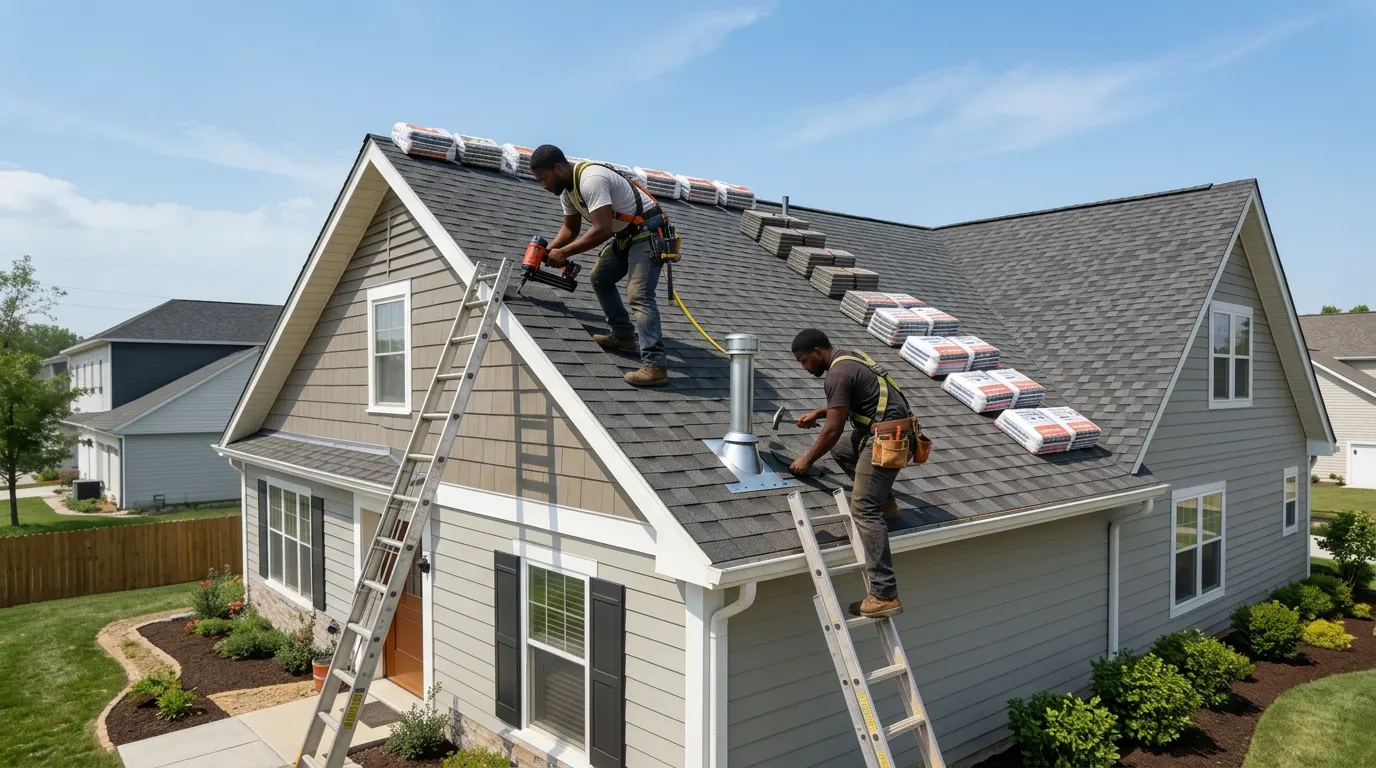
Butts County roofs and wind
Roofing for Jackson, GA Homeowners
Jackson is a small county seat with a mix of older and 2000s homes, in a county that saw serious tornado damage in January 2023. Here is how to look at a roof with that in mind.
Jackson at a Glance
- Location
- 39.8 miles southeast of central Atlanta (straight line)
- County
- Butts County
- Population (2023 estimate)
- 5,854
- Housing units
- 2,011
- Median year homes were built
- 1986
- Owner-occupied homes
- 52%
- Detached single-family homes
- 69%
- Built before 1970
- 27%
- Built 2010 or later
- 7%
Sources: US Census Bureau 2023 Gazetteer, Vintage 2023 population estimates, and American Community Survey 2023 5-year estimates for the place. County is taken at the place’s center point; some communities extend into other counties.

The storm that put roofs on everyone’s mind
On January 12, 2023, a tornado outbreak crossed central Georgia. One track, rated high-end EF2 with peak winds near 130 mph, ran about 32 miles from Spalding County northeast through Butts County, including Jenkinsburg and the Jackson Lake area, according to a summary of the outbreak. It caused major damage and a death near Jackson Lake. FEMA recorded the event as DR-4685-GA, a major disaster declaration for severe storms, straight-line winds and tornadoes in Georgia.
That track did not need to cross your street to matter. Wind events scatter debris widely, and shingles that were lifted but not removed can sit for years looking fine from the driveway. EF ratings help explain this. As the National Weather Service explains, an EF rating comes from wind estimated by surveying damage, and EF1 begins at 86 mph. A home at the edge of a storm can see gusts well below the peak while still ending up with loosened tabs, damaged flashing or a torn ridge.
So when people search for roofing Jackson GA, they might have a leak today, a nagging question about what that storm did, or a roof that has simply reached a certain age. Those are three different conversations, and it helps to know which one you are having.
Look from the ground before anyone climbs up
You do not need to walk on your own roof to learn plenty about it, and we would rather you did not. From the yard, with binoculars if you have them, and from inside the attic on a bright day, look for these:
- Shingles with creases across them, a sign that the wind lifted and folded them back.
- Patches of darker or differently colored shingles left over from an earlier repair.
- Granules collecting at downspout outlets, or bald spots where the mat is exposed.
- Bent or missing flashing around chimneys, vents and where a roof meets a wall.
- A ridge line that sags, rather than running straight.
- Daylight through the roof deck from inside the attic, or dark stains around nail tips and rafters.
- Staining on upstairs ceilings, particularly below valleys and around bath fans.
After a storm, photograph what you can see safely from the ground, with dates, before anything is moved. If tree limbs are on the roof or lines are down, stay clear and call the utility or 911. For damage you think is storm related, your insurer’s process and deadlines govern what happens next, so read the policy or call your agent. We cannot advise you on a claim, though we can describe the roof’s condition.
What the age of Jackson’s homes implies
Census estimates describe a housing stock that spreads across many decades. The median year built is 1986. Around 8% of homes predate 1950, 19% date from 1950 to 1969, 27% from 1970 to 1989, 39% from 1990 to 2009 and just 7% from 2010 onward. The town itself has deep roots, founded in 1826 and growing after the railroad arrived in 1882, says a general history. Jackson serves as the Butts County seat, about 40 miles southeast of central Atlanta.
Homes from before 1970 (about 27%)
Multiple roof layers are possible, and board sheathing may lie under the shingles instead of plywood. Older ventilation can be limited, and any old roofing or siding product deserves a question before removal, since EPA lists roofing and siding shingles among the places asbestos may be found.
Homes from 1970 to 1989 (about 27%)
Most have been re-roofed at least once by now, though possibly not recently. Ask what is under the current layer and how flashing was handled. Reused flashing from an earlier job is worth checking.
Homes from 1990 to 2009 (about 39%)
This is the group where an original or first-replacement roof may be coming due. A house from around 2000 could easily still have its first shingles, depending on product and exposure. Age alone is not a verdict, so inspect the actual condition.
Homes built since 2010 (about 7%)
Younger roofs usually call for repairs rather than replacement. Storm damage, poorly sealed pipe boots and bath fans vented incorrectly are more likely than simple wear.
Only about 52% of homes are owner-occupied, and about 69% are detached houses. On rentals, roof leaks may be reported late, so a ceiling stain might be months old by the time anyone hears about it. Landlords can head that off with a yearly look at attics and ceilings.
Repair or replace: a fair way to decide
The honest answer usually comes from a few specific observations, not from a rule of thumb. Consider a repair when the damage is confined to a small area, the rest of the shingles still lie flat and hold their granules, and the deck underneath is solid. A targeted roof leak repair may be all that is needed, especially for a failed pipe boot or a bit of lifted flashing.
Lean toward replacement when shingles across several slopes are brittle or curling, when leaks keep moving around, when you find soft decking over a broad area, or when the roof already has more layers than the permit office will accept. A full roof replacement is also easier to justify when other exterior work is coming anyway. New siding or exterior trim often pairs well with new flashing.
A few questions are worth asking anyone who inspects your roof, including us:
Show me
Ask for photos of each problem area, with an explanation of what each one means. A claim you cannot see is hard to weigh.
What about the deck?
Ask how soft or rotted decking is handled if it shows up after tear-off, and how such work is priced, since nobody can see it beforehand.
Where does the water go?
Ask how valleys, flashing and drip edges will be handled, because shingles are rarely where leaks actually begin.
How will the attic breathe?
Ask whether intake and exhaust ventilation are balanced. Heat and moisture trapped in an attic shorten a roof’s life and can cause trouble below.
Details that matter when wind is the worry
No ordinary shingle roof is storm-proof, and no one should tell you otherwise. A new roof can still be put together with wind in mind. Shingle makers publish nailing patterns and wind ratings, and those instructions are worth reading. Ask how the starter course and edges will be fastened, since wind tends to get its first grip at eaves and rakes. Ask about the ridge, the sealing of vents, and whether old flashing is being reused or replaced. On a house with large trees close by, look at the limbs as well: branches over a roof scrape shingles in ordinary weather, drop leaves into valleys and become the real hazard in a storm. An arborist can tell you which ones are a concern.
If someone knocks on your door after a storm
Roofing salespeople often appear after a big weather event. Some are perfectly fine, but take your time regardless. Ask for a written scope, get the company’s full name and contact details, and read anything before you sign it, particularly a document tied to an insurance claim. You can ask your insurer how they handle inspections, and you can get a second opinion. A roof that survived the storm will generally still be there next week, while a tarp over a real opening is a reasonable short-term step if water is getting in.
For a new roof on a new structure or addition, see our roof installation page. Twelve25 is licensed and insured, and offers free estimates, with a clear scope and pricing up front.
After the roof: water at the edges
Roof problems and foundation problems often share a cause. EPA’s termite guidance recommends maintaining gutters and downspouts and fixing leaks right away, and those same steps help the structure in several ways. Blocked gutters after an autumn of falling leaves can back water up under the first row of shingles and into fascia. Scheduling gutter cleaning is one of the simplest things an owner can do for a roof.
Inside, roof leaks rarely stay where they start. Water follows rafters and pipes, so a ceiling stain may appear several feet from the actual opening. EPA’s mold guide says wet materials should be dried within 24 to 48 hours where possible. If a leak has already marked a ceiling, plan to repair the roof first, then replace wet insulation and handle the drywall and paint once everything is dry.
Who to ask about permits
City Hall is at 134 S. Oak Street, and the city’s website carries a Licenses and Permits link. Published permit guidance names a City of Jackson Building Department at that address, along with a building permit application. Please ask the office directly whether your roof job needs a permit and whether it limits the number of layers. A property outside the city limits may fall under Butts County instead. Check before filing, and do the same if you are closer to Locust Grove or Griffin, which have their own offices.
If you are not sure whether your roof needs anything at all, an outside opinion can be useful. We serve Jackson and can look at the roof as part of a free estimate. You can send us a request with any photos you have from the ground.
Sources for Local Facts
- FEMA: DR-4685-GA, Severe Storms, Straight-line Winds and Tornadoes
- National Weather Service: The Enhanced Fujita Scale
- U.S. EPA: Learn About Asbestos
- U.S. EPA: Termites, How to Identify and Control Them
- U.S. EPA: A Brief Guide to Mold, Moisture and Your Home
- City of Jackson, GA: City website
- Third-party permit directory: Jackson, Butts County
- Wikipedia: Tornado outbreak of January 12, 2023
- Wikipedia: Jackson, Georgia (general history)
Let’s Build Something Great Together.
Ready to start your next construction or remodeling project? Tell us about your space and request a free estimate.